


Ethereum news today brings positive momentum to investors and traders worldwide. Ethereum (ETH), the second-largest cryptocurrency by market capitalisation, has demonstrated impressive strength by gaining over 3.5% in the past 24 hours, successfully retaking the psychologically important $3,200 price level. This significant price movement comes amid growing institutional interest, positive technical indicators, and several fundamental catalysts that are reshaping the Ethereum news landscape today. As traders analyse these developments, the question on everyone’s mind is whether this upward momentum can sustain itself and push ETH toward even higher price targets in the coming weeks.
Current Ethereum Price Analysis and Market Performance
ETH Price Breaks Through Key Resistance Levels
Ethereum news today highlights a remarkable recovery as ETH’s price climbed from approximately $3,090 to surpass the $3,200 mark, representing a gain of more than 3.5%. This price action demonstrates strong buying pressure and renewed investor confidence in the Ethereum ecosystem. The breakthrough above $3,200 is particularly significant as this level has acted as both support and resistance multiple times throughout recent trading sessions.
Trading volume has increased substantially alongside the price surge, with over $18 billion in 24-hour trading volume recorded across major cryptocurrency exchanges. This volume surge indicates genuine market interest rather than a thin rally driven by low liquidity. Technical analysts point to several positive indicators, including the Relative Strength Index (RSI) moving into bullish territory without being overbought, and the Moving Average Convergence Divergence (MACD) showing a bullish crossover on the daily chart.
Market Sentiment Shifts Bullish on Ethereum
The broader cryptocurrency market sentiment has turned increasingly bullish, and Ethereum news today reflects this positive shift. Bitcoin’s stability above $42,000 has created a favourable environment for altcoins, with Ethereum leading the charge among large-cap digital assets. Market participants are showing increased confidence in ETH price action, with social media sentiment indicators and on-chain metrics both trending positively.
Fear and Greed Index readings have moved toward the “greed” territory, suggesting that investors are becoming more optimistic about near-term price action. Funding rates on perpetual futures contracts remain positive but not excessively high, indicating healthy leverage levels without the risk of a major liquidation cascade that could reverse gains.
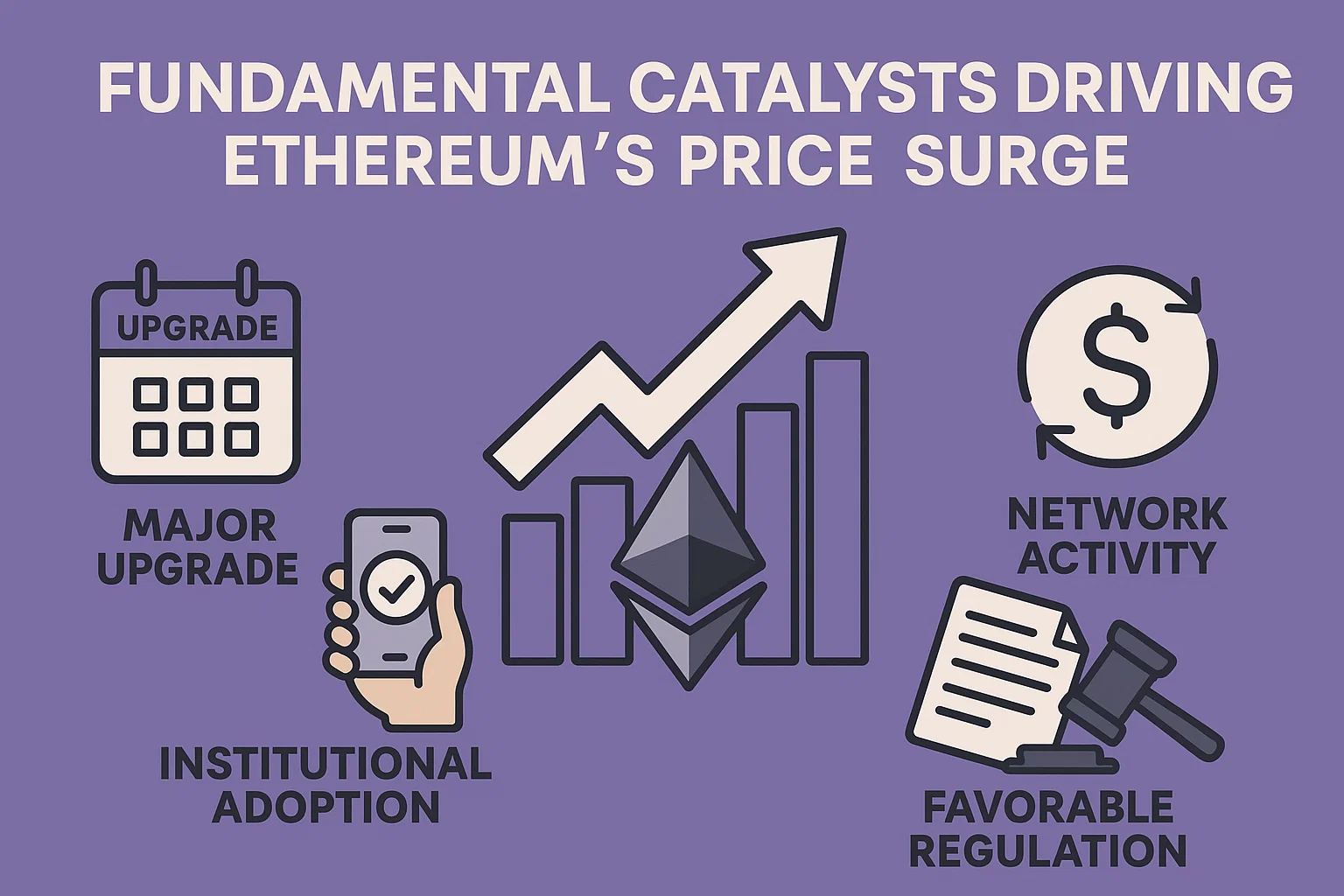
Fundamental Catalysts Driving Ethereum’s Price Surge
Ethereum Network Upgrades and Development Progress
One of the most significant factors in Ethereum news today is the continued progress on network upgrades and scalability solutions. The Ethereum development community has been working tirelessly on implementing improvements that enhance transaction throughput, reduce gas fees, and improve overall network efficiency. The upcoming Dencun upgrade, which includes proto-danksharding (EIP-4844), is expected to dramatically reduce costs for Layer 2 rollups.
These technical improvements are not just theoretical – they’re already showing real-world impact. Ethereum Layer 2 solutions like Arbitrum, Optimism, Base, and zkSync have processed millions of transactions with significantly lower fees than the mainnet, making Ethereum-based applications more accessible to everyday users. This scalability progress directly addresses one of the main criticisms of the Ethereum network and strengthens the bullish case for ETH price appreciation.
Institutional Adoption and Spot ETF Developments
Ethereum news today wouldn’t be complete without discussing the growing institutional interest in ETH. Following the successful launch of Bitcoin spot ETFs, attention has shifted toward potential Ethereum ETF products. Several major financial institutions have filed applications with the Securities and Exchange Commission (SEC) for spot Ethereum ETFs, and market participants are watching these developments closely.
The prospect of spot Ethereum ETFs has created anticipation similar to what Bitcoin experienced before its ETF approvals. Institutional investors who may have been hesitant to directly hold cryptocurrency are now preparing to gain exposure through regulated investment vehicles. This anticipated influx of institutional capital represents a significant bullish catalyst that could drive sustained price appreciation in the coming months.
Major financial institutions, including BlackRock, Fidelity, and Grayscale, have shown serious interest in offering Ethereum investment products. BlackRock’s iShares Ethereum Trust has already garnered significant attention, and the firm’s CEO, Larry Fink, has spoken positively about Ethereum’s potential as a tokenisation platform for real-world assets.
On-Chain Metrics and Network Activity
Ethereum Network Fundamentals Remain Strong
Diving deeper into Ethereum news today, on-chain data reveals robust network fundamentals that support the current price rally. The number of active Ethereum addresses has been trending upward, indicating growing network usage and adoption. Daily transaction counts remain healthy, demonstrating that Ethereum continues to be the preferred platform for decentralised applications (dApps), DeFi protocols, and NFT marketplaces.
Ethereum staking metrics also paint a bullish picture. Over 30 million ETH is currently staked in the network, representing approximately 25% of the total supply. This substantial amount of staked ETH reduces the circulating supply available for trading, creating natural upward pressure on prices. The staking yield, currently averaging around 3-4%, provides an attractive alternative to traditional savings accounts and bonds, encouraging long-term holding behaviour.
DeFi Total Value Locked Shows Growth
The decentralised finance (DeFi) sector, which is predominantly built on Ethereum, continues to show impressive growth. Total Value Locked (TVL) across Ethereum DeFi protocols has increased substantially, with major platforms like Aave, Lido, MakerDAO, and Uniswap commanding billions of dollars in locked assets. This TVL growth indicates that users are increasingly trusting Ethereum-based protocols with their capital.
The Ethereum ecosystem benefits from powerful network effects – as more value flows into DeFi protocols, more developers are incentivised to build on Ethereum, which in turn attracts more users and capital. This virtuous cycle strengthens Ethereum’s position as the dominant smart contract platform and provides fundamental support for ETH price appreciation.
Technical Analysis: What Charts Tell Us
Key Support and Resistance Levels
From a technical perspective, Ethereum news today brings encouraging chart patterns that suggest further upside potential. The immediate support level now sits at $3,150, with stronger support at the $3,000 psychological level. On the upside, immediate resistance appears at $3,250, with the next major resistance zone between $3,400 and $3,500.
The daily candlestick pattern shows a decisive move above the 50-day moving average, a bullish signal that often precedes sustained uptrends. The 200-day moving average sits at approximately $2,850, meaning the ETH price is trading comfortably above this long-term trend indicator. Technical analysts often view this as confirmation of a bull market structure.
Chart Patterns Suggest Bullish Continuation
Several chart patterns visible in the current Ethereum price action suggest that the uptrend could continue. An ascending triangle pattern on the 4-hour chart indicates accumulation and potential for a breakout to the upside. The volume profile shows strong support built up between $3,000 and $3,200, suggesting that buyers are willing to defend these levels aggressively.
Fibonacci retracement levels from the recent swing high to swing low show that Ethereum has reclaimed the 0.618 golden ratio level, often viewed as a key indicator of trend strength. If the ETH price can hold above this level, technical analysts anticipate a retest of the previous high around $3,700, representing approximately 15% upside potential from current levels.
Ethereum Versus Bitcoin: The Flippening Debate
ETH/BTC Ratio Shows Relative Strength
An important aspect of Ethereum news today involves analysing Ethereum’s performance relative to Bitcoin. The ETH/BTC trading pair has shown signs of strength, with Ethereum outperforming Bitcoin on a percentage basis over various timeframes. This relative strength is significant because it suggests that capital is rotating from Bitcoin into Ethereum, a pattern often seen during altcoin seasons.
The “Flippening” – a theoretical event where Ethereum’s market capitalisation surpasses Bitcoin’s – remains a topic of intense debate within the cryptocurrency community. While Bitcoin currently maintains a substantial market cap lead, Ethereum’s superior utility as a smart contract platform and its growing DeFi ecosystem provide compelling arguments for continued market share gains.
Use Case Advantages Drive Ethereum Adoption
Unlike Bitcoin, which primarily serves as digital gold and a store of value, Ethereum functions as a decentralised computing platform with numerous use cases. This functional diversity gives Ethereum multiple growth vectors, including DeFi, NFTs, gaming, real-world asset tokenisation, decentralised autonomous organisations (DAOs), and enterprise blockchain solutions.
The breadth of Ethereum use cases creates more opportunities for network growth and value accrual. Every transaction, smart contract interaction, and token deployment on Ethereum requires ETH to pay for gas fees, creating consistent demand for the asset. This utility-driven demand provides a different value proposition compared to Bitcoin’s primarily speculative nature.
Expert Predictions and Price Targets
Analyst Forecasts for Ethereum Price
Ethereum news today includes several bullish price predictions from prominent cryptocurrency analysts and institutions. Many analysts view the $3,200 reclaim as confirmation that Ethereum has established a solid base for the next leg up. Conservative price targets for the near term (1-3 months) range from $3,500 to $4,000, while more aggressive forecasts suggest potential for the ETH price to reach $4,500 to $5,000 if current momentum continues.
Long-term predictions are even more optimistic, with some analysts suggesting that Ethereum could reach $10,000 or higher within the next 12-24 months if key catalysts align. These catalysts include successful implementation of scalability upgrades, approval of spot Ethereum ETFs, continued DeFi growth, and favourable regulatory developments.
Standard Chartered Bank, a major financial institution, published research suggesting that Ethereum could reach $8,000 by the end of 2024, citing improving fundamentals and institutional adoption. VanEck, a prominent asset management firm, has published even more bullish long-term forecasts, projecting that the ETH price could potentially reach $50,000+ by 2030 in their bull case scenario.
Risk Factors and Bearish Scenarios
While Ethereum news today is predominantly positive, responsible analysis requires acknowledgement of potential risks. Regulatory uncertainty remains a significant concern, particularly regarding whether ETH might be classified as a security by regulatory authorities. Adverse regulatory decisions could negatively impact price and adoption.
Competition from alternative Layer 1 blockchains like Solana, Avalanche, and Cardano presents another risk factor. If these competing platforms can capture significant market share in DeFi or NFTs, it could slow Ethereum’s growth trajectory. Additionally, macroeconomic factors, including interest rate decisions, inflation data, and traditional market performance, continue to influence cryptocurrency prices.
Ethereum Layer 2 Ecosystem Growth
Scaling Solutions Drive Network Efficiency
A major component of Ethereum news today is the explosive growth of Layer 2 scaling solutions. These protocols, built on top of Ethereum’s base layer, provide faster transactions and dramatically lower fees while inheriting Ethereum’s security guarantees. Arbitrum, Optimism, Polygon, Base, and zkSync are leading the Layer 2 race, collectively processing more transactions per day than the Ethereum mainnet.
Ethereum Layer 2 adoption has reached unprecedented levels, with major decentralised exchanges, lending protocols, and NFT marketplaces deploying on these scaling solutions. This migration alleviates congestion on the mainnet while expanding Ethereum’s overall capacity to serve more users and applications. The fees collected by Layer 2 sequencers and the ETH used for data availability on mainnet both contribute to Ethereum’s value proposition.
The upcoming Dencun upgrade will further enhance Layer 2 efficiency by implementing proto-danksharding (EIP-4844), which creates a new transaction type specifically designed for Layer 2 data availability. This upgrade is expected to reduce Layer 2 transaction costs by 10-100x, making Ethereum-based applications competitive with centralised alternatives in terms of user experience and cost.
NFT Market Recovery and Impact on Ethereum
Digital Collectables Find New Momentum
Ethereum news today also encompasses developments in the NFT sector, which has shown signs of recovery after a prolonged downturn. Trading volume on major NFT marketplaces like OpenSea, Blur, and LooksRare has increased, with several high-profile collections experiencing renewed interest. Ethereum remains the dominant blockchain for high-value NFT transactions, processing over 80% of NFT trading volume.
The NFT market’s recovery matters for the ETH price because every NFT transaction requires ETH to pay for gas fees and serves as the primary currency for most NFT purchases. Additionally, many NFT projects hold treasuries in ETH, creating large “HODLers” who support price stability. The cultural significance of Ethereum-native NFT collections like CryptoPunks and Bored Ape Yacht Club reinforces Ethereum’s position as the premium blockchain for digital art and collectables.
Real-World Asset Tokenisation Opportunity
Traditional Finance Meets Blockchain
One of the most exciting narratives in Ethereum news today involves the tokenisation of real-world assets (RWAs). Major financial institutions are exploring how to represent traditional assets like bonds, real estate, commodities, and securities on the blockchain. Ethereum, with its mature smart contract infrastructure and institutional familiarity, is emerging as the preferred platform for these tokenisation initiatives.
Ethereum tokenisation projects have already launched various RWA-backed assets, including Treasury bill tokens, real estate investment tokens, and commodity-backed stablecoins. The potential market size for tokenised assets is enormous – some estimates suggest that trillions of dollars worth of traditional assets could eventually be represented on blockchain networks. If Ethereum captures even a small percentage of this market, the fundamental value proposition for ETH becomes substantially stronger.
BlackRock CEO Larry Fink has repeatedly emphasised the potential of tokenisation, describing it as “the next generation for markets.” BlackRock’s blockchain initiatives, including their BUIDL fund launched on Ethereum, demonstrate a serious institutional commitment to this vision. As tokenisation gains traction, Ethereum stands to benefit significantly as the infrastructure layer for this emerging sector.
Regulatory Developments and Government Relations
Clearer Regulatory Framework Emerges
Recent Ethereum news today includes positive developments on the regulatory front. Various government agencies and lawmakers have begun developing clearer frameworks for cryptocurrency regulation, reducing uncertainty that has historically weighed on the market. The SEC’s approval of Bitcoin spot ETFs set an important precedent, and the agency’s approach to Ethereum ETF applications will significantly impact future price action.
Ethereum regulatory clarity is particularly important because of its classification debate. While Bitcoin is widely accepted as a commodity, Ethereum’s status has been less certain due to its transition from proof-of-work to proof-of-stake and its more complex ecosystem. Recent statements from regulatory officials and the treatment of Ethereum futures products suggest growing acceptance of ETH as a commodity rather than a security.
International regulatory developments also matter for Ethereum’s global adoption. The European Union’s Markets in Crypto-Assets (MiCA) regulation provides a comprehensive framework that could accelerate institutional adoption in Europe. Similarly, positive regulatory developments in Asian markets, including Singapore, Hong Kong, and Japan, create additional growth opportunities for Ethereum adoption.
Ethereum Energy Efficiency and Environmental Impact
Proof-of-Stake Reduces Carbon Footprint
An often-overlooked aspect of Ethereum news today is the network’s dramatic improvement in energy efficiency following The Merge. Ethereum’s transition from proof-of-work to proof-of-stake consensus reduced the network’s energy consumption by approximately 99.95%, addressing one of the main criticisms levelled against blockchain technology.
This environmental improvement has significant implications for institutional adoption. Many large institutions have ESG (Environmental, Social, and Governance) mandates that previously prevented them from investing in energy-intensive cryptocurrencies. Ethereum’s proof-of-stake model removes this barrier, potentially opening the door to substantial institutional capital that was previously off-limits.
The reduced energy consumption also improves Ethereum’s public perception and reduces regulatory risk related to environmental concerns. As climate change remains a critical global issue, Ethereum’s sustainable consensus mechanism provides a competitive advantage over proof-of-work blockchains and aligns with the values of environmentally conscious investors.
Comparison with Alternative Smart Contract Platforms
Ethereum Maintains Dominant Position
While Ethereum news today is positive, it’s important to contextualise Ethereum’s performance within the broader smart contract platform landscape. Competitors like Solana, Avalanche, BNB Chain, and Cardano have gained market share in recent years, each offering different technical approaches and value propositions.
Despite competition, Ethereum maintains several key advantages, including the largest developer community, the most mature DeFi ecosystem, the strongest network effects, the highest quality security auditors, and the deepest liquidity across token pairs. These advantages create significant switching costs and moat effects that help Ethereum defend its market leadership position.
Network effects in blockchain platforms are particularly powerful because developers prefer building where users are, and users prefer platforms with the most applications. This creates a self-reinforcing cycle that is difficult for competitors to break. While alternative platforms may offer superior transaction speeds or lower fees, Ethereum’s ecosystem advantages often outweigh these technical specifications.
How to Participate in Ethereum’s Growth
Investment Strategies and Considerations
For investors interested in capitalising on Ethereum news today, several participation methods are available. Direct purchase and holding of ETH remains the most straightforward approach, providing full exposure to price appreciation. Investors can purchase ETH through cryptocurrency exchanges like Coinbase, Kraken, Binance, or Gemini, then transfer their holdings to secure wallets for long-term storage.
Ethereum staking offers an alternative approach that generates yield while holding ETH. Investors can stake their ETH directly by running a validator node (requiring 32 ETH) or through liquid staking providers like Lido, Rocket Pool, or centralised exchanges that offer staking services. Staking yields currently range from 3-4% annually, providing passive income in addition to potential price appreciation.
For investors who prefer regulated investment vehicles, the potential approval of spot Ethereum ETFs would provide a convenient option for gaining ETH exposure through traditional brokerage accounts. This approach eliminates concerns about wallet security and private key management while providing the tax advantages of holding securities in retirement accounts.
More sophisticated investors might consider exposure to Ethereum ecosystem tokens, including Layer 2 tokens, DeFi protocol tokens, or infrastructure projects built on Ethereum. These assets can provide leveraged exposure to Ethereum’s growth but carry additional risks related to project-specific execution and competition.
Ethereum Community and Developer Activity

Thriving Ecosystem Drives Innovation
The strength of Ethereum news today ultimately derives from the vibrant community of developers, researchers, and users building on the platform. Ethereum consistently ranks as the blockchain with the most active developers, with thousands of contributors working on core protocol development, Layer 2 solutions, DApps, and developer tools.
Developer activity serves as a leading indicator for ecosystem growth. Platforms with strong developer communities tend to see more innovation, better applications, and ultimately more user adoption. Ethereum’s developer-friendly tools, comprehensive documentation, and abundant learning resources create a positive feedback loop that attracts talent from traditional software development into blockchain development.
The Ethereum Foundation and various grant programs provide funding for ecosystem development, ensuring continued innovation across infrastructure, research, and application layers. This coordinated support system helps Ethereum maintain its technological edge despite being one of the oldest smart contract platforms.
Conclusion
Today’s impressive price action, with Ethereum news today showing gains of over 3.5% and a successful retake of the $3,200 level, represents more than just short-term volatility – it reflects growing confidence in Ethereum’s fundamental value proposition. The combination of strong technical indicators, positive on-chain metrics, institutional interest, successful scaling solutions, and a thriving developer ecosystem creates a compelling bullish case for ETH price appreciation in the months ahead.
As Ethereum continues implementing technological upgrades, expanding its real-world asset tokenisation capabilities, and potentially gaining approval for spot ETF products, the groundwork is being laid for sustained growth. While short-term volatility is inevitable in cryptocurrency markets, Ethereum’s position as the dominant smart contract platform provides a strong foundation for long-term value creation.
Read more: Ethereum News Regulatory Updates Today SEC Legal Changes
