


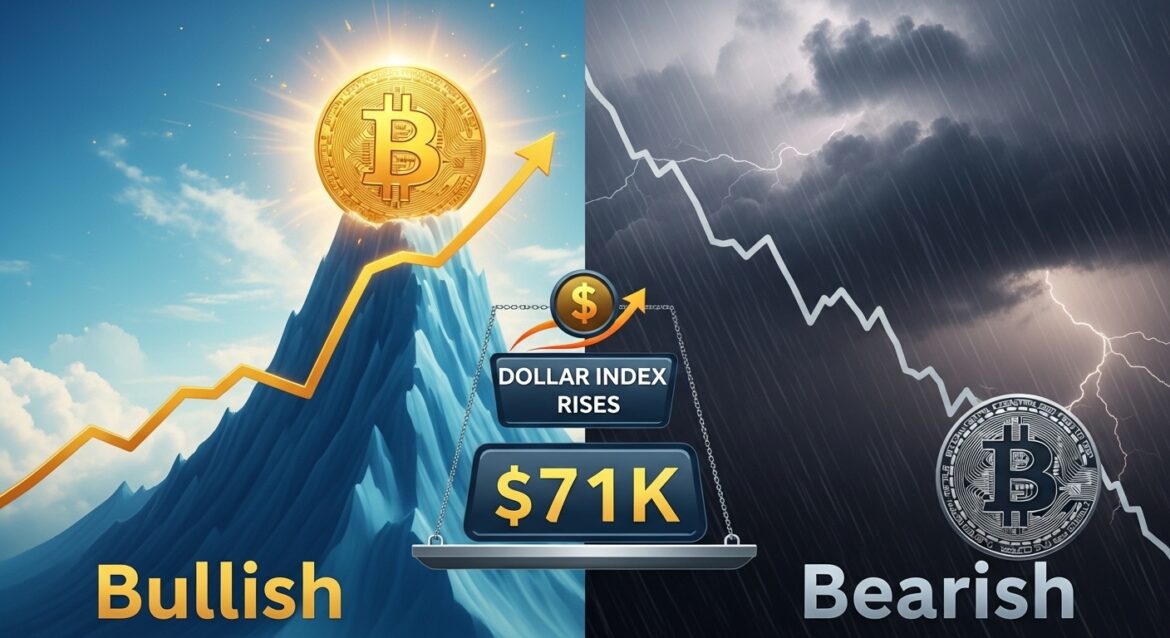
The latest Bitcoin news today shows that Bitcoin Holds Above $71K, even as the U.S. Dollar Index (DXY) climbs toward a three-month high. This unusual market dynamic has sparked a major debate among traders and analysts: Is this strength a sign of continued bullish momentum, or is it a warning signal for a potential correction?
Historically, Bitcoin and the U.S. dollar tend to move in opposite directions. When the dollar strengthens, risk assets such as cryptocurrencies often struggle. Yet, despite the rising dollar, Bitcoin Holds Above $71K, demonstrating remarkable resilience in the face of macroeconomic pressure. This situation raises an important question for investors: Could Bitcoin be entering a new phase where it decouples from traditional financial indicators?
With global markets facing geopolitical tensions, interest rate uncertainty, and increasing institutional participation, Bitcoin’s price behavior is attracting intense attention. In this article, we will explore why Bitcoin Holds Above $71K, how the U.S. Dollar Index impacts cryptocurrency markets, and whether the current trend signals bullish continuation or a bearish reversal.
Why Bitcoin Holds Above $71K Despite a Strong Dollar
The fact that Bitcoin Holds Above $71K while the dollar strengthens is noteworthy because the two assets usually show an inverse relationship.
A stronger dollar typically reduces investor appetite for riskier assets. When the dollar rises, investors often move capital toward safer instruments like treasury bonds. However, Bitcoin’s current stability suggests a shift in market dynamics.
Several factors may explain why Bitcoin Holds Above $71K during this period.
First, institutional demand for Bitcoin continues to grow. Large financial institutions and hedge funds are increasingly viewing Bitcoin as a strategic asset rather than a speculative one.
Second, spot Bitcoin ETFs have significantly increased liquidity and accessibility. Since their approval, billions of dollars have flowed into Bitcoin investment products, strengthening the market’s foundation.
Third, global macro uncertainty is pushing investors toward alternative stores of value. While gold traditionally plays this role, Bitcoin is increasingly considered “digital gold.”
These developments help explain why Bitcoin Holds Above $71K despite macroeconomic headwinds.
Bitcoin Holds Above $71K: What It Means for the Crypto Market
The fact that Bitcoin Holds Above $71K carries significant implications for the broader cryptocurrency ecosystem.
Bitcoin often acts as the bellwether for the entire crypto market. When Bitcoin maintains strong price levels, it provides confidence to investors in other digital assets.
Many altcoins, including Ethereum, Solana, and BNB, tend to follow Bitcoin’s direction. If Bitcoin Holds Above $71K, it could signal continued strength across the crypto sector.
Market sentiment is also influenced by psychological price levels. The $70,000 region has historically acted as a critical support and resistance zone.
Holding above this level indicates that buyers remain active and willing to defend the price. This behavior is typically associated with bullish market structures.
However, the sustainability of this support will depend on broader economic conditions and liquidity flows.
The Impact of the U.S. Dollar Index on Bitcoin
Understanding the Dollar Index
The U.S. Dollar Index (DXY) measures the value of the U.S. dollar against a basket of major currencies. When the index rises, it indicates strengthening global demand for the dollar. Traditionally, a strong dollar places downward pressure on commodities and alternative assets. Therefore, the fact that Bitcoin Holds Above $71K while the DXY approaches a three-month high is particularly unusual.
Why the Dollar Matters for Bitcoin
The relationship between Bitcoin and the dollar is rooted in liquidity cycles.
When the Federal Reserve tightens monetary policy or raises interest rates, the dollar typically strengthens. This often leads to reduced liquidity in global markets. Reduced liquidity can negatively impact cryptocurrencies because they rely heavily on speculative capital flows. However, if Bitcoin Holds Above $71K even during dollar strength, it may indicate deeper structural demand.
Institutional Demand Supporting Bitcoin
One of the main reasons Bitcoin Holds Above $71K is the growing influence of institutional investors. Large asset managers and financial firms have dramatically increased their exposure to Bitcoin. This shift has fundamentally changed market dynamics compared to previous crypto cycles.
Institutional investors often have longer investment horizons and deeper capital reserves. Their presence helps stabilize the market during periods of volatility. Spot Bitcoin ETFs have played a major role in this transformation. These investment vehicles allow traditional investors to gain exposure to Bitcoin without directly managing cryptocurrency wallets.
As more institutional money enters the market, the likelihood that Bitcoin Holds Above $71K increases.
Macro Factors Influencing Bitcoin’s Price
Bitcoin’s performance does not exist in isolation. Several macroeconomic factors currently shape the cryptocurrency market.
Interest rate expectations remain one of the most influential variables. If central banks maintain high rates, liquidity conditions could tighten.
Geopolitical tensions also affect market sentiment. Global uncertainty often drives investors toward assets perceived as safe havens. Inflation trends are another critical factor. When inflation rises, Bitcoin is frequently promoted as a hedge against currency devaluation. These macro forces collectively influence whether Bitcoin Holds Above $71K or eventually experiences a correction.
Technical Analysis: Key Support and Resistance Levels
Technical indicators suggest that Bitcoin’s current price structure remains bullish.
The $70,000 region has become a crucial support level. As long as Bitcoin Holds Above $71K, the market maintains a strong upward bias. Traders are closely watching the next resistance levels near $73,000 and $75,000.
A decisive breakout above these levels could trigger another rally. On the downside, if Bitcoin falls below $70,000, it may test support near $67,000. Despite these possibilities, the fact that Bitcoin Holds Above $71K indicates that buyers remain in control for now.
Could Bitcoin Decouple From the Dollar?
A growing number of analysts believe that Bitcoin may eventually decouple from traditional financial indicators such as the dollar. Historically, Bitcoin’s correlation with macro assets has fluctuated significantly. At times it behaves like a technology stock, reacting strongly to liquidity changes. At other times, it acts more like a commodity or store of value.
If Bitcoin holds above $71K despite a strengthening dollar, it could signal the early stages of a new market paradigm. This would mean Bitcoin’s value is increasingly driven by its own adoption and network fundamentals rather than global currency trends.
Market Sentiment and Investor Psychology
Investor sentiment plays a crucial role in determining whether Bitcoin Holds Above $71K.
Cryptocurrency markets are heavily influenced by psychological levels and market narratives.
When investors believe that Bitcoin will continue rising, buying pressure increases. This self-reinforcing cycle can drive prices higher. Currently, sentiment appears cautiously optimistic. While traders remain aware of macro risks, the strong price performance has boosted confidence.
If optimism continues to grow, it could help ensure that Bitcoin Holds Above $71K for an extended period.
Future Outlook for Bitcoin
Looking ahead, the future of Bitcoin will depend on several key developments. Institutional adoption remains one of the most powerful drivers. As more financial institutions integrate Bitcoin into their portfolios, demand could rise significantly. Regulatory clarity will also shape the market’s trajectory. Clear regulations may attract additional institutional investment.
Technological advancements within the Bitcoin ecosystem could further strengthen its position. If these trends continue, the scenario where Bitcoin Holds Above $71K may only represent the beginning of a larger bullish cycle.
However, investors should remain cautious because cryptocurrency markets are known for sudden volatility.
Conclusion
The current market situation presents a fascinating development in the cryptocurrency landscape. Despite macroeconomic pressure from a rising U.S. Dollar Index, Bitcoin Holds Above $71K, demonstrating remarkable resilience.
This strength may signal growing institutional support, increasing global adoption, and a shift in how investors perceive Bitcoin as an asset.
Whether this trend proves bullish or bearish will depend on macroeconomic conditions, market liquidity, and investor sentiment in the coming weeks.
For now, the fact that Bitcoin Holds Above $71K suggests that buyers remain confident in Bitcoin’s long-term potential.
If you want to stay ahead in the cryptocurrency market, keep tracking Bitcoin Holds Above $71K and monitor key macro indicators that could influence BTC’s next major move.
See more;Crypto Firm Accidentally Sends $40bn Bitcoin to Users | 2026