


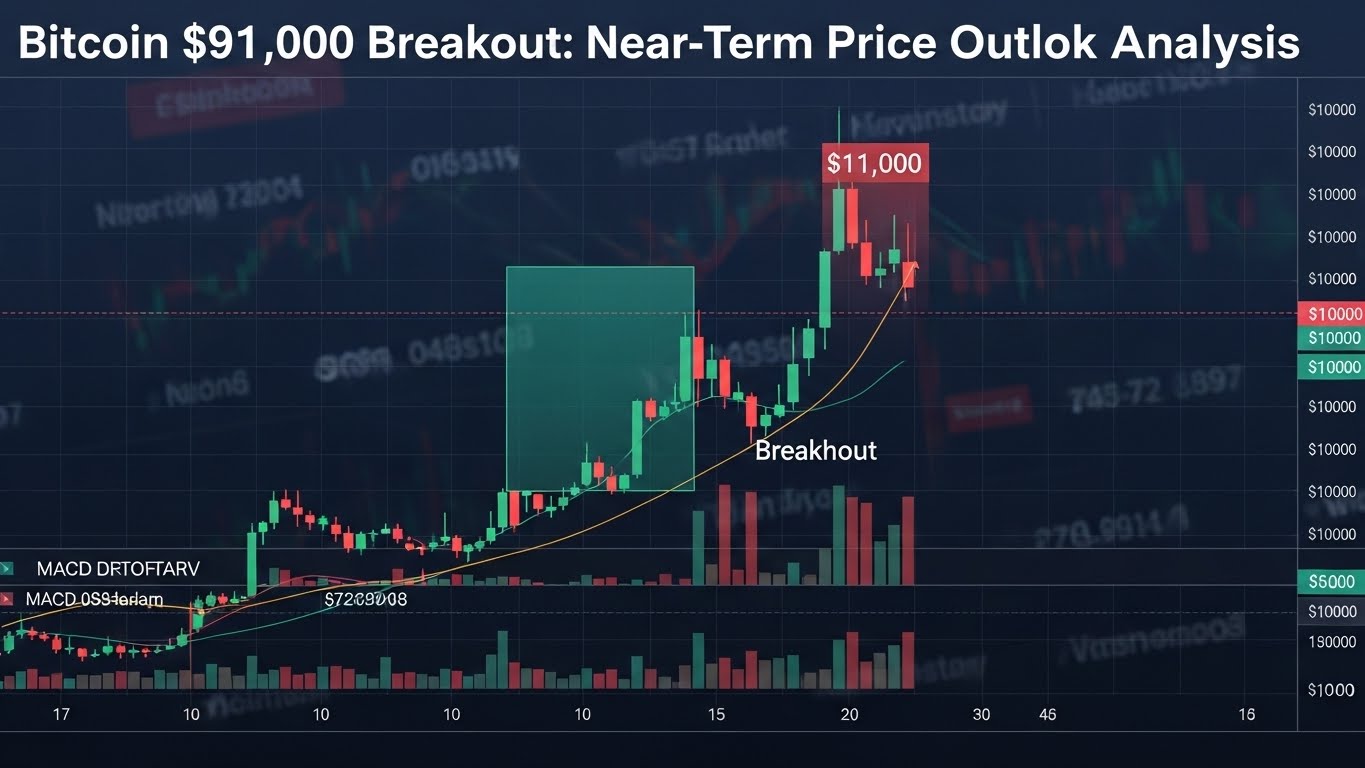
The cryptocurrency market stands at a pivotal junction as Bitcoin $91,000 breakout attempts dominate trader discussions and market analysis. This critical resistance level has emerged as the defining threshold that could determine whether the leading digital asset continues its bullish momentum or faces a period of consolidation. Understanding the significance of this Bitcoin $91,000 breakout attempt requires examining multiple technical indicators, market sentiment, and historical price patterns that have shaped cryptocurrency trading dynamics throughout recent months. As investors worldwide monitor every price fluctuation, the question remains whether Bitcoin possesses sufficient buying pressure to decisively breach this psychological and technical barrier that has captured the attention of both institutional and retail participants.
Significance of the $91,000 Resistance Level
The Bitcoin resistance at $91,000 represents more than just an arbitrary price point in the cryptocurrency ecosystem. This level has developed into a formidable barrier through repeated testing and rejection, creating what technical analysts identify as a significant supply zone. When Bitcoin approaches this threshold, selling pressure historically intensifies as traders who purchased at higher levels seek to minimize losses, while profit-takers capitalize on the rally from lower support levels.
Market psychology plays an equally important role in establishing the importance of this Bitcoin $91,000 breakout scenario. Round numbers naturally attract attention in financial markets, and the $91,000 mark sits strategically below the psychologically significant $100,000 level that has long represented a milestone target for cryptocurrency enthusiasts. Breaking through $91,000 would not only eliminate immediate overhead resistance but would also clear the path toward testing six-figure valuations that could trigger substantial FOMO-driven buying activity.
Historical price action reveals that Bitcoin typically experiences multiple failed breakout attempts before successfully breaching major resistance levels. Each rejection strengthens the significance of the barrier while simultaneously building potential energy for an eventual explosive move. The current consolidation pattern beneath $91,000 mirrors similar formations that preceded significant rallies in previous market cycles, suggesting that patient accumulation may be occurring at current price levels.
Technical Analysis of Bitcoin’s Current Market Structure
Examining Bitcoin technical analysis reveals several competing narratives about the cryptocurrency’s near-term trajectory. The daily chart displays an ascending triangle pattern, with higher lows forming since the recent correction, while the $91,000 level acts as horizontal resistance. This formation typically resolves with an upward breakout, particularly when accompanied by increasing volume during the consolidation phase, which current data suggests is developing gradually.
Moving averages provide additional context for understanding Bitcoin market trends surrounding this critical juncture. The 50-day moving average has crossed above the 200-day moving average in what technical traders recognize as a golden cross formation, historically a bullish indicator that suggests longer-term upward momentum. However, the proximity of current prices to these moving averages indicates that a breakdown below $91,000 could trigger significant technical selling as short-term holders rush to protect capital.
The Relative Strength Index currently hovers in neutral territory, neither overbought nor oversold, which leaves considerable room for movement in either direction. This balanced positioning means the Bitcoin $91,000 breakout attempt will likely be determined by external catalysts rather than purely technical factors. Volume analysis shows declining participation during recent consolidation, which often precedes significant directional moves as the market awaits a catalyst to break the current equilibrium.
Fundamental Factors Influencing the Breakout Probability
Beyond technical considerations, multiple fundamental factors influence whether the Bitcoin $91,000 breakout materializes successfully. Institutional adoption continues accelerating, with spot Bitcoin ETFs maintaining steady inflows despite broader market volatility. These investment vehicles have fundamentally altered Bitcoin’s market structure by providing traditional investors with regulated access to cryptocurrency exposure without the complexities of self-custody or exchange account management.
Macroeconomic conditions significantly impact cryptocurrency market analysis as Bitcoin increasingly correlates with traditional risk assets. Federal Reserve monetary policy, inflation data, and global economic growth projections all influence investor appetite for alternative assets like Bitcoin. The current environment presents mixed signals, with persistent inflation supporting the digital scarcity narrative while concerns about economic slowdown potentially dampening risk appetite across all speculative investments.
Regulatory developments continue shaping market sentiment around the Bitcoin $91,000 breakout attempt. Clearer regulatory frameworks in major economies generally support higher valuations by reducing uncertainty and encouraging institutional participation. Conversely, regulatory crackdowns or restrictive legislation can quickly reverse bullish momentum regardless of technical setups. The ongoing dialogue between cryptocurrency advocates and regulatory bodies worldwide creates an ever-present backdrop of uncertainty that traders must navigate.
On-Chain Metrics and Their Implications for Price Direction
Blockchain data provides unique insights unavailable in traditional financial markets, offering valuable context for evaluating the Bitcoin $91,000 breakout probability. Exchange balances have declined substantially over recent months, indicating that investors are moving Bitcoin into long-term storage rather than keeping it readily available for selling. This behavior typically signals conviction among holders and reduces available supply that could suppress price appreciation.
The number of addresses holding substantial Bitcoin quantities continues growing, suggesting accumulation by larger players who typically maintain longer investment horizons. When combined with declining exchange reserves, this pattern indicates that available supply for immediate trading decreases while demand potentially increases, creating favorable supply-demand dynamics for a Bitcoin price prediction that includes upward movement through resistance levels.
Mining activity and hash rate metrics demonstrate network security and miner confidence in future valuations. Despite recent price volatility, the hash rate maintains elevated levels, indicating that miners continue investing in infrastructure despite periodic profitability squeezes. This commitment suggests confidence in higher future prices that would justify current operational expenditures and capital investments in mining equipment.
Historical Precedents for Major Bitcoin Breakouts
Examining previous Bitcoin breakout patterns provides valuable context for current market conditions. The 2020 breakout above $20,000 resistance required multiple attempts over several weeks before finally achieving a decisive move that led to the 2021 bull market peak. Similarly, the breach of $10,000 in 2019 followed extended consolidation and multiple failed attempts before triggering substantial upward momentum.
These historical examples demonstrate that major Bitcoin resistance levels rarely yield on the first attempt. Instead, they require gradual erosion through repeated testing that exhausts sellers and builds confidence among buyers. The current situation around $91,000 follows this familiar pattern, with multiple approaches to the level creating a coiling effect that could eventually lead to explosive movement once sufficient buying pressure accumulates.
The timeframe required for major breakouts varies considerably based on broader market conditions and catalyst availability. In bull markets characterized by strong momentum and positive sentiment, resistance levels may yield relatively quickly. During periods of uncertainty or negative macro conditions, consolidation can extend for months before resolution. Understanding where the current market fits within this spectrum helps inform realistic expectations for the Bitcoin $91,000 breakout timeline.
Market Sentiment and Psychological Factors
Cryptocurrency markets remain heavily influenced by sentiment and crowd psychology, making these factors crucial for cryptocurrency market analysis around key price levels. Social media activity, search trends, and sentiment indicators reveal that interest in Bitcoin remains elevated compared to historical bear market periods but has not yet reached the euphoric levels that characterize market tops. This moderate enthusiasm suggests room for further appreciation without immediately triggering concerns about overheated conditions.
The Fear and Greed Index, which aggregates multiple sentiment indicators, currently registers in the greed territory but not at extreme levels. This positioning indicates optimism about future price appreciation while suggesting that widespread panic or euphoria has not yet developed. For the Bitcoin $91,000 breakout to succeed sustainably, moderate optimism provides a healthier foundation than extreme sentiment that often precedes sharp reversals.
Retail versus institutional sentiment often diverges during critical market junctures. Current data suggests institutional participants maintain measured optimism reflected in steady ETF inflows, while retail sentiment exhibits more volatility based on short-term price movements. This divergence can create opportunities when institutional conviction eventually influences broader market sentiment and drives sustained directional moves through key resistance levels.
Trading Strategies Around the $91,000 Level
For active traders, the Bitcoin $91,000 breakout attempt creates both opportunities and risks requiring careful strategy formulation. Breakout traders typically wait for decisive moves above resistance accompanied by strong volume before entering positions, accepting the risk of false breakouts in exchange for confirmation that genuine momentum has developed. This approach sacrifices the opportunity to buy at the absolute bottom but reduces the probability of getting trapped in failed breakout attempts.
Conversely, range traders capitalize on the rejection patterns around key levels by selling near resistance and buying near support. This strategy works effectively during extended consolidation periods but carries substantial risk if a genuine breakout occurs and prices move sharply against the position. The current environment around the Bitcoin resistance at $91,000 requires traders to carefully assess whether consolidation will continue or resolution is imminent.
Risk management becomes paramount when trading around critical technical levels. Position sizing, stop-loss placement, and profit-taking strategies all require careful consideration given the elevated volatility that typically accompanies breakout attempts. Traders must balance the desire to capture significant moves with the necessity of protecting capital during false signals that inevitably occur when markets test major resistance levels.
The Role of Derivatives Markets in Breakout Dynamics
Bitcoin derivatives markets increasingly influence spot price movements, making Bitcoin technical analysis incomplete without considering futures and options positioning. Open interest in futures contracts provides insights into leverage levels in the market, with elevated open interest sometimes indicating crowded positioning vulnerable to liquidation cascades that can trigger rapid price movements in either direction.
Options markets reveal trader expectations through the analysis of implied volatility and strike price concentrations. Large clusters of call options at or above $91,000 suggest that many traders anticipate an upward Bitcoin $91,000 breakout, while put option positioning below this level indicates hedging activity or bearish speculation. The interaction between these opposing forces influences price action as expiration dates approach and market makers adjust hedging positions.
Funding rates in perpetual futures contracts indicate the cost of maintaining leveraged positions and reveal whether long or short positions dominate. Positive funding rates indicate that longs pay shorts, suggesting bullish positioning, while negative rates reflect bearish dominance. Monitoring these metrics provides real-time insights into trader sentiment and positioning that complement traditional technical analysis when evaluating Bitcoin market trends around critical price levels.
Macroeconomic Catalysts That Could Trigger Movement
The success or failure of the Bitcoin $91,000 breakout attempt may ultimately depend less on technical factors and more on macroeconomic developments that shift risk appetite across global markets. Central bank policy decisions, particularly from the Federal Reserve, continue to exert outsized influence on cryptocurrency valuations as interest rate expectations affect discount rates applied to all risk assets, including digital currencies.
Inflation trends provide another crucial variable in the Bitcoin price prediction equation. Persistent inflation that exceeds central bank targets supports Bitcoin’s value proposition as a scarce digital asset that cannot be inflated away through monetary policy decisions. However, the relationship between inflation and Bitcoin prices proves more complex than simple correlation, as the policy responses to inflation can create headwinds for risk assets that temporarily override the longer-term inflation hedge narrative.
Global economic growth projections influence risk appetite across all speculative investments. Strong economic growth typically supports cryptocurrency valuations by increasing disposable income available for investment and creating optimistic sentiment that encourages risk-taking. Economic slowdowns or recession fears generally trigger a flight to safety that pressures cryptocurrency prices regardless of technical setups or individual asset fundamentals.
Alternative Scenarios Beyond the Breakout
While focus naturally gravitates toward the Bitcoin $91,000 breakout scenario, prudent analysis requires considering alternative outcomes that could materialize instead. A rejection from current levels followed by a retracement toward key support zones represents a realistic possibility, particularly if broader market conditions deteriorate or unexpected negative catalysts emerge. Identifying critical support levels where buying interest might reemerge helps traders prepare for this scenario.
Extended consolidation beneath $91,000 without a decisive move in either direction constitutes another plausible outcome. Markets frequently require more time to resolve major technical patterns than participants anticipate, with consolidation periods sometimes extending for months before eventual resolution. This scenario tests trader patience but also provides opportunities for accumulation at relatively stable price levels for those with longer investment horizons.
A false breakout that briefly exceeds $91,000 before reversing sharply represents the most challenging scenario for traders to navigate. These whipsaw movements trigger stop-losses on both sides of the market and often create substantial volatility before the market establishes a clear direction. Historical Bitcoin breakout patterns include numerous examples of false starts that ultimately resolved in the opposite direction from the initial move.
Portfolio Management Considerations for Bitcoin Investors
Long-term investors approaching the Bitcoin $91,000 breakout from a portfolio management perspective face different considerations than short-term traders. Position sizing relative to overall portfolio allocation requires careful assessment based on individual risk tolerance and investment objectives. While Bitcoin’s potential returns attract attention, the volatility and risk characteristics demand thoughtful integration into diversified investment strategies.
Dollar-cost averaging through regular periodic purchases represents a popular strategy for accumulating digital asset trading positions that reduces the impact of timing risk. This approach proves particularly valuable around major resistance levels where price direction remains uncertain, allowing investors to build positions gradually without attempting to predict short-term movements or time perfect entries.
Rebalancing strategies help maintain target portfolio allocations as cryptocurrency prices fluctuate substantially. When Bitcoin appreciates significantly following a successful Bitcoin $91,000 breakout, its portfolio weight may grow beyond intended levels, creating concentrated risk that prudent management would address through partial profit-taking and rebalancing into other assets. Conversely, price declines may create opportunities to restore target allocations through strategic purchases.
The Broader Cryptocurrency Market Context
Bitcoin’s position as the leading cryptocurrency means its performance around the Bitcoin $91,000 breakout attempt influences the entire digital asset ecosystem. Altcoins typically exhibit high correlation with Bitcoin price movements, with successful Bitcoin breakouts often triggering sympathetic rallies across alternative cryptocurrencies. Understanding these correlation patterns helps investors position portfolios to capitalize on broader market movements rather than focusing exclusively on Bitcoin.
However, correlation patterns occasionally break down during specific market phases, with altcoins underperforming or outperforming Bitcoin based on unique factors affecting different segments of the cryptocurrency market. Bitcoin dominance metrics track Bitcoin’s market capitalization percentage relative to total cryptocurrency market capitalization, providing insights into whether capital flows favor the leading cryptocurrency or alternative options offering different risk-return profiles.
The maturation of cryptocurrency markets increasingly segments investor preferences across different digital asset categories. Bitcoin appeals primarily to investors seeking digital gold characteristics and store of value properties, while alternative cryptocurrencies attract capital seeking exposure to specific blockchain use cases, decentralized applications, or emerging technology trends. This segmentation means that cryptocurrency market analysis requires understanding distinctions between different digital asset categories rather than treating the market as monolithic.
Expert Perspectives and Institutional Forecasts
Professional analysts and institutional research teams offer varying perspectives on the likelihood and implications of a successful Bitcoin $91,000 breakout. Bullish analysts cite improving fundamentals, increasing institutional adoption, and favorable macroeconomic conditions as factors supporting higher valuations and successful breach of current resistance levels. Their Bitcoin price prediction models often incorporate network growth metrics, adoption rates, and scarcity arguments that justify substantially higher valuations over multi-year timeframes.
More conservative analysts emphasize risks, including regulatory uncertainty, macroeconomic headwinds, and technical overhead resistance that could prevent sustained upward movement. These perspectives typically recommend cautious positioning and risk management rather than aggressive accumulation around major resistance levels. The diversity of professional opinions underscores the genuine uncertainty surrounding near-term price direction and the wisdom of maintaining balanced perspectives that acknowledge both opportunities and risks.
Institutional forecasts from major financial services firms increasingly include cryptocurrency price targets as digital assets gain mainstream acceptance. These forecasts range widely based on different assumptions about adoption rates, regulatory developments, and macroeconomic conditions. The inclusion of cryptocurrency analysis in traditional financial research represents a significant milestone in digital asset maturation, even as forecast accuracy remains challenged by the relative youth and volatility of cryptocurrency markets.
Conclusion
The Bitcoin $91,000 breakout attempt represents a defining moment for near-term cryptocurrency market direction, with implications extending well beyond this specific price level. Technical patterns suggest building pressure that will eventually resolve in a significant directional move, while fundamental factors present a complex mixture of supportive and challenging conditions. Investors and traders must balance the opportunity for substantial gains against risks of false breakouts and extended consolidation that could test patience and conviction.
Successful navigation of this critical juncture requires combining technical analysis, fundamental research, and prudent risk management within a coherent strategy aligned with individual objectives and risk tolerance. Whether the Bitcoin $91,000 breakout succeeds or fails in the immediate term, the longer-term trajectory for Bitcoin and cryptocurrency markets likely depends more on sustained adoption growth, regulatory clarity, and macroeconomic conditions than any single technical level.
As Bitcoin tests this crucial resistance, market participants should remain informed about developing catalysts, monitor key technical indicators, and maintain flexible strategies that can adapt to evolving market conditions. The coming weeks will likely provide clarity about whether Bitcoin market trends support a decisive move higher or require additional consolidation before the next significant rally phase begins.
Ready to take action? Stay informed about the latest Bitcoin $91,000 breakout developments by following real-time market analysis and expert insights. Whether you’re a long-term investor or active trader, understanding the dynamics around this critical resistance level will help you make informed decisions as Bitcoin’s near-term outlook crystallizes.
See more; MicroStrategy Plans Raise Fed Decision Bitcoin Nears $100K
