


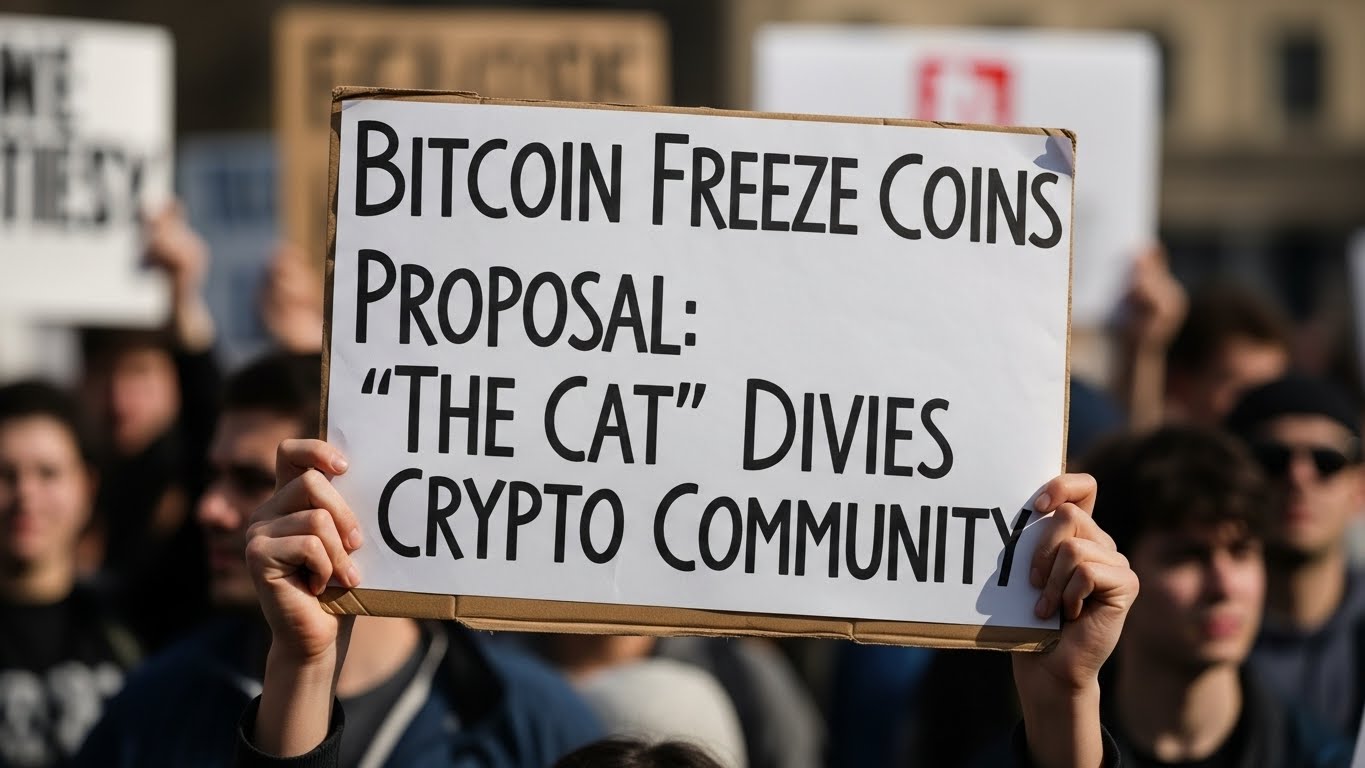
The Bitcoin freeze coins proposal has emerged as one of the most contentious debates in cryptocurrency history, threatening to shake the very foundations of what Bitcoin represents. When developers introduced “The Cat” protocol suggestion, they ignited a firestorm that has split the Bitcoin community down the middle. This Bitcoin protocol change proposal raises fundamental questions about immutability, censorship resistance, and the future direction of the world’s first cryptocurrency. As stakeholders grapple with the implications, the controversy surrounding this Bitcoin improvement proposal has become impossible to ignore, forcing everyone from casual holders to mining operations to take sides in what may become a defining moment for digital currency.
The debate centers on whether Bitcoin should implement mechanisms that could potentially freeze or blacklist certain coins, a concept that seems to contradict everything the cryptocurrency was designed to achieve. Understanding this controversy requires examining the technical details, philosophical implications, and potential consequences of such a dramatic shift in Bitcoin’s fundamental architecture.
Understanding The Cat Proposal and Its Controversial Foundation
The Bitcoin freeze coins proposal known as “The Cat” emerged from discussions within certain developer circles who argue that Bitcoin needs additional tools to combat illicit activities and comply with evolving regulatory frameworks. This proposed cryptocurrency governance mechanism would theoretically allow designated entities or consensus mechanisms to flag and potentially freeze specific Bitcoin addresses or transaction outputs deemed problematic.
Proponents of this Bitcoin protocol change argue that the cryptocurrency ecosystem has matured beyond its early libertarian ideals and must adapt to real-world pressures. They point to high-profile cases of ransomware attacks, terrorist financing, and money laundering that have tarnished Bitcoin’s reputation and attracted unwanted regulatory scrutiny. The technical implementation would involve creating a new layer within the Bitcoin protocol that maintains a dynamic list of flagged addresses, preventing coins from those sources from being spent or accepted by compliant nodes.
The mechanism proposed in “The Cat” would function through a form of distributed consensus where miners, node operators, or designated authorities could vote on which addresses should face restrictions. This crypto asset freezing capability would be enforced at the protocol level, making it impossible for frozen coins to move regardless of who controls the private keys. The proposal suggests implementing this through a soft fork, which theoretically wouldn’t require all network participants to upgrade immediately.
However, the technical details reveal significant complexity. The system would need to track tainted coins through the blockchain’s entire history, applying heuristics to determine which outputs inherit the “frozen” status. This creates a computational burden and introduces unprecedented levels of chain analysis into Bitcoin’s base layer, something that fundamentally alters how the network operates.
The Philosophical Battle Over Blockchain Immutability
Critics of “The Cat” argue that introducing any form of crypto asset freezing capability destroys this fundamental characteristic. They contend that once you create the technical infrastructure to freeze coins, you’ve essentially built a kill switch into Bitcoin that can be exploited by governments, malicious actors, or through simple human error. The decentralized currency control that made Bitcoin revolutionary would be compromised, transforming it into something resembling a traditional financial system with gatekeepers and censorship.
The Bitcoin community debate has exposed deep ideological divisions. One camp maintains that Bitcoin’s primary value lies in being an uncensorable, permissionless system where code, not human judgment, determines what transactions are valid. They argue that any deviation from this principle, regardless of good intentions, sets a dangerous precedent that undermines Bitcoin’s core purpose as a hedge against monetary manipulation and financial censorship.
Conversely, supporters of the Bitcoin improvement proposal argue that absolute immutability creates a moral hazard. They point out that Bitcoin’s current design inadvertently provides a safe harbor for criminals and creates legal risks for legitimate businesses forced to accept potentially tainted coins. These advocates suggest that some form of governance mechanism is necessary for Bitcoin to achieve mainstream adoption and avoid eventual regulatory crackdowns that could be far more damaging.
The debate extends beyond technical considerations into questions of governance and decision-making authority. Who would decide which coins deserve freezing? What appeals process would exist? How would false positives be handled? These questions reveal that the Bitcoin protocol change proposed by “The Cat” isn’t merely technical but represents a fundamental shift in Bitcoin’s governance model.
Technical Implications and Implementation Challenges
One major concern involves the scalability impact of tracking frozen addresses. Bitcoin nodes currently validate transactions by checking cryptographic signatures and ensuring inputs haven’t been previously spent. Adding a layer that cross-references every transaction against a dynamic blacklist significantly increases computational requirements. As this list grows over time, node operation becomes more resource-intensive, potentially forcing smaller operators off the network and leading to greater centralization.
The Bitcoin consensus mechanism would also require substantial modification. Currently, consensus revolves around the longest valid chain determined by proof-of-work mining. Introducing frozen coin logic means nodes must maintain synchronized blacklists and agree on which coins carry restricted status. This creates new attack vectors where disagreements about list contents could fragment the network into incompatible chains, each following different freezing rules.
Privacy implications represent another critical concern. The infrastructure needed to implement crypto asset freezing would necessitate comprehensive chain analysis capabilities built into every node. This surveillance apparatus could be repurposed to track any Bitcoin user’s transaction history, even those not targeted for freezing. The very existence of such tools within Bitcoin’s base layer would fundamentally alter the privacy guarantees users currently expect.
The Bitcoin improvement proposal also faces the challenge of determining coin ancestry. Bitcoin’s UTXO model means coins from clean and tainted sources frequently mix in transactions. Should an output receiving ninety-nine percent clean coins and one percent frozen coins be entirely blocked? Partially restricted? These edge cases multiply exponentially as coins circulate through the network, creating an enforcement nightmare that could accidentally freeze vast amounts of legitimate Bitcoin.
Community Response and Growing Division
Mining pools represent a critical constituency in this dispute. Some large operations have expressed openness to the Bitcoin protocol change, viewing it as necessary to maintain regulatory compliance and avoid potential sanctions. These miners argue that refusing to adapt could result in governments forcing exchanges to delist Bitcoin or imposing punitive regulations that damage the entire ecosystem. Their pragmatic approach prioritizes Bitcoin’s survival and mainstream adoption over strict ideological purity.
However, a significant portion of the mining community vehemently opposes the Bitcoin freeze coins proposal. These operators argue that implementing censorship tools makes Bitcoin indistinguishable from traditional payment networks and eliminates the unique value proposition that justifies their substantial infrastructure investments. Several prominent mining pools have announced they would continue mining a non-freezing version of Bitcoin even if “The Cat” gains majority support, raising the specter of a contentious hard fork.
Development teams are similarly divided. Some contributors view the proposal as a necessary evil to ensure Bitcoin’s long-term viability in an increasingly regulated world. They argue that refusing to address legitimate concerns about illicit activity provides ammunition to critics calling for Bitcoin’s prohibition. These developers emphasize that the cryptocurrency governance mechanisms proposed could be designed with strong safeguards against abuse.
Meanwhile, other developers have declared the entire concept fundamentally incompatible with Bitcoin’s design philosophy. Core contributors have published extensive technical critiques explaining why blockchain immutability cannot be selectively compromised without destroying the trust assumptions that make Bitcoin valuable. These critics argue that once censorship infrastructure exists, it will inevitably expand beyond its original scope, following the same pattern seen in traditional financial surveillance systems.
Regulatory Pressures Driving the Debate Forward
The Bitcoin protocol change advocates point to increasing regulatory coordination across jurisdictions as evidence that Bitcoin must adapt or face coordinated government action. Recent enforcement actions against privacy-focused cryptocurrencies and mixing services demonstrate that authorities are willing to target blockchain networks themselves rather than just individual users. Proponents argue that voluntary implementation of crypto asset freezing capabilities might preempt more draconian measures imposed from outside.
Regulatory bodies have sent mixed signals about whether Bitcoin’s current architecture is acceptable long-term. Some officials have praised its transparency and traceability compared to cash, suggesting current chain analysis techniques provide sufficient oversight. Others have explicitly called for technical changes that would give law enforcement greater control over cryptocurrency flows, lending credence to arguments that the Bitcoin improvement proposal represents an inevitable compromise.
However, opponents of “The Cat” argue that appeasing regulatory demands through protocol changes sets a dangerous precedent. They contend that authorities will continuously demand additional controls once they establish the principle that Bitcoin can and should implement censorship mechanisms. This slippery slope concern suggests that accepting the Bitcoin freeze coins proposal today leads to demands for transaction reversals, inflation mechanisms, or other features that completely undermine Bitcoin’s original purpose.
The Bitcoin community debate has also highlighted tensions between different jurisdictions. While some countries might demand freezing capabilities, others may view censorship-resistant cryptocurrency as strategically valuable. This creates a coordination problem where implementing controls to satisfy one government risks making Bitcoin illegal or useless in others, potentially fragmenting the global network along geopolitical lines.
Economic Consequences and Market Impact
This fungibility loss would ripple throughout the Bitcoin ecosystem. Exchanges would need to implement extensive screening procedures to avoid accidentally accepting frozen coins, adding costs and delays to transactions. Merchants accepting Bitcoin would face liability risks if they unknowingly receive restricted coins, potentially driving many businesses away from Bitcoin acceptance. The Bitcoin protocol change would transform simple transactions into complex legal evaluations, dramatically reducing Bitcoin’s utility as a medium of exchange.
Institutional investors who currently view Bitcoin as digital gold might reassess their positions if the network implements freezing capabilities. The cryptocurrency governance structure that allows coin freezing creates counterparty risk previously absent from Bitcoin holdings. Large investors who value Bitcoin specifically because it lacks human discretion in transaction validation might rotate into alternative assets or traditional gold, triggering substantial price declines.
The Bitcoin community debate has already created market uncertainty as traders attempt to price the probability and consequences of “The Cat” implementation. Volatility has increased as different stakeholder groups signal their positions, with significant capital flows between Bitcoin and alternative cryptocurrencies that explicitly reject any form of transaction censorship. This market fragmentation demonstrates how controversial protocol changes can damage network effects even before implementation.
Mining economics would also face disruption. The Bitcoin consensus mechanism currently provides clear incentives where miners maximize profit by including all valid transactions with sufficient fees. Introducing frozen coin logic creates scenarios where miners must choose between profit maximization and compliance with freezing rules, potentially leading to mining centralization as only large, legally compliant operations can navigate the complex requirements.
Alternative Approaches and Compromise Solutions
Another suggested compromise involves enhanced transparency tools rather than freezing mechanisms. Instead of implementing crypto asset freezing capabilities, Bitcoin could standardize interfaces for chain analysis that help businesses and regulators identify potentially problematic transactions without actually blocking them. This preserves individual freedom while providing authorities the information they claim to need, shifting responsibility for compliance to endpoints rather than the protocol itself.
Some developers have proposed time-limited freezing mechanisms that would automatically expire, preventing permanent blacklisting while theoretically addressing emergencies. This Bitcoin improvement proposal variant would require periodic renewal of frozen status through network consensus, creating friction that discourages frivolous censorship while allowing temporary responses to acute threats. Critics argue this still fundamentally compromises Bitcoin’s architecture and creates the infrastructure for abuse.
Community governance models represent another exploration area. Rather than centralizing freeze authority with specific entities, some proposals suggest implementing decentralized governance where token holders vote on blacklist additions through cryptographic voting mechanisms. Advocates argue this distributed cryptocurrency governance approach prevents single points of failure and abuse while maintaining some ability to respond to genuine emergencies. Opponents counter that any voting system inevitably favors large holders and creates plutocratic control incompatible with Bitcoin’s egalitarian ideals.
The Bitcoin community debate around these alternatives reveals that finding compromise proves difficult when fundamental values conflict. Each proposed solution makes tradeoffs that some stakeholders find unacceptable, suggesting the community may ultimately split rather than reach consensus on modifications to Bitcoin’s core architecture.
Historical Precedents and Lessons from Previous Controversies
The block size debate of 2015-2017 represents the most relevant comparison. The Bitcoin protocol change controversy centered on increasing Bitcoin’s transaction capacity through larger blocks, with proponents arguing that scalability was necessary for mainstream adoption, while opponents claimed it would centralize node operation. The dispute ultimately resulted in Bitcoin Cash forking away from Bitcoin, creating two separate networks with different philosophies. Both survive, but neither achieved the dominance the unified network previously held, demonstrating how community splits can fragment network effects and reduce overall value.
The SegWit implementation offers another instructive example. This Bitcoin improvement proposal succeeded despite significant opposition by implementing changes as a soft fork that didn’t force immediate upgrades. However, SegWit’s activation process revealed deep governance challenges within Bitcoin, with different stakeholder groups wielding varying degrees of influence over protocol direction. The ultimate compromise satisfied neither camp entirely, suggesting that contentious changes often result in suboptimal outcomes that please nobody.
Ethereum’s DAO hard fork provides lessons from outside Bitcoin’s ecosystem. When Ethereum implemented protocol changes to reverse theft from the DAO smart contract, it permanently split the community between Ethereum and Ethereum Classic. That decision directly challenged blockchain immutability principles, and despite Ethereum’s subsequent success, it forever altered perceptions about the network’s censorship resistance. This precedent worries Bitcoin critics of “The Cat” who fear similar permanent reputation damage.
These historical cases demonstrate that the Bitcoin community debate over freezing capabilities could result in permanent network splits if implemented over significant opposition. The cryptocurrency governance challenges inherent to decentralized networks mean that determined minorities can continue operating alternative versions, fragmenting liquidity and reducing the network’s overall utility and value proposition.
The Path Forward and Potential Outcomes
Alternatively, the proposal could gain sufficient support for implementation despite opposition. This scenario would likely trigger a contentious hard fork as dissenting miners and users continue operating a non-freezing version of Bitcoin. The resulting split would create cryptocurrency governance uncertainty as markets determine which network retains the “Bitcoin” brand and value. History suggests both chains would survive but with significantly reduced network effects compared to the unified network, potentially opening opportunities for alternative cryptocurrencies to capture market share.
A third possibility involves compromise solutions gaining traction that modify “The Cat” proposal to address the most severe criticisms. These compromise approaches might implement limited freezing capabilities with strict safeguards, sunset clauses, or voluntary opt-in mechanisms. While such compromises might prevent network splits, they risk satisfying nobody and still fundamentally altering Bitcoin’s characteristics in ways that could damage long-term value proposition.
The regulatory environment will heavily influence outcomes. If governments coordinate aggressive action against Bitcoin using current architecture as justification, pressure for the Bitcoin improvement proposal will intensify regardless of community sentiment. Conversely, if authorities accept Bitcoin’s existing structure or focus enforcement on off-chain businesses rather than protocol itself, the urgency for implementing crypto asset freezing capabilities diminishes significantly.
Technical developments in privacy technology could also shift the debate. Advances in zero-knowledge proofs, confidential transactions, or other privacy-enhancing technologies might render freezing mechanisms ineffective or create alternative ways to balance transparency and censorship resistance. The Bitcoin freeze coins proposal might become obsolete if technical innovations address underlying concerns through different approaches that don’t compromise fundamental principles.
Conclusion
The Bitcoin freeze coins proposal known as “The Cat” represents far more than a technical upgrade or routine protocol modification. This controversy strikes at the heart of what Bitcoin is, what it should become, and whether its founding principles can survive contact with mainstream adoption pressures and regulatory realities. The outcome of this Bitcoin community debate will define cryptocurrency’s trajectory for decades to come.
As stakeholders continue wrestling with these fundamental questions, the broader cryptocurrency ecosystem watches closely. The decisions made regarding blockchain immutability, cryptocurrency governance, and crypto asset freezing capabilities will establish precedents affecting not just Bitcoin but all decentralized networks claiming to offer censorship-resistant alternatives to traditional finance.
The Bitcoin protocol change controversy reveals tensions that cannot be easily resolved through technical solutions alone. Questions about who controls Bitcoin, what values it should embody, and how it balances competing interests ultimately require philosophical rather than merely technical answers. Whether the community can navigate these challenges while preserving Bitcoin’s core value proposition remains the defining question of this pivotal moment.
For investors, developers, and users navigating this uncertainty, staying informed about the Bitcoin freeze coins proposal developments is essential. The decisions made in the coming months will shape Bitcoin’s fundamental characteristics and determine whether it remains the censorship-resistant digital gold that attracted early adopters or evolves into something fundamentally different that serves different purposes for different audiences.
Take action now: Join the conversation by engaging with Bitcoin development communities, educating yourself about the technical details of the Bitcoin freeze coins proposal, and making your voice heard in this critical debate that will determine the future of decentralized currency. The outcome depends on informed participation from community members who understand what’s at stake in this watershed moment for cryptocurrency history.
