


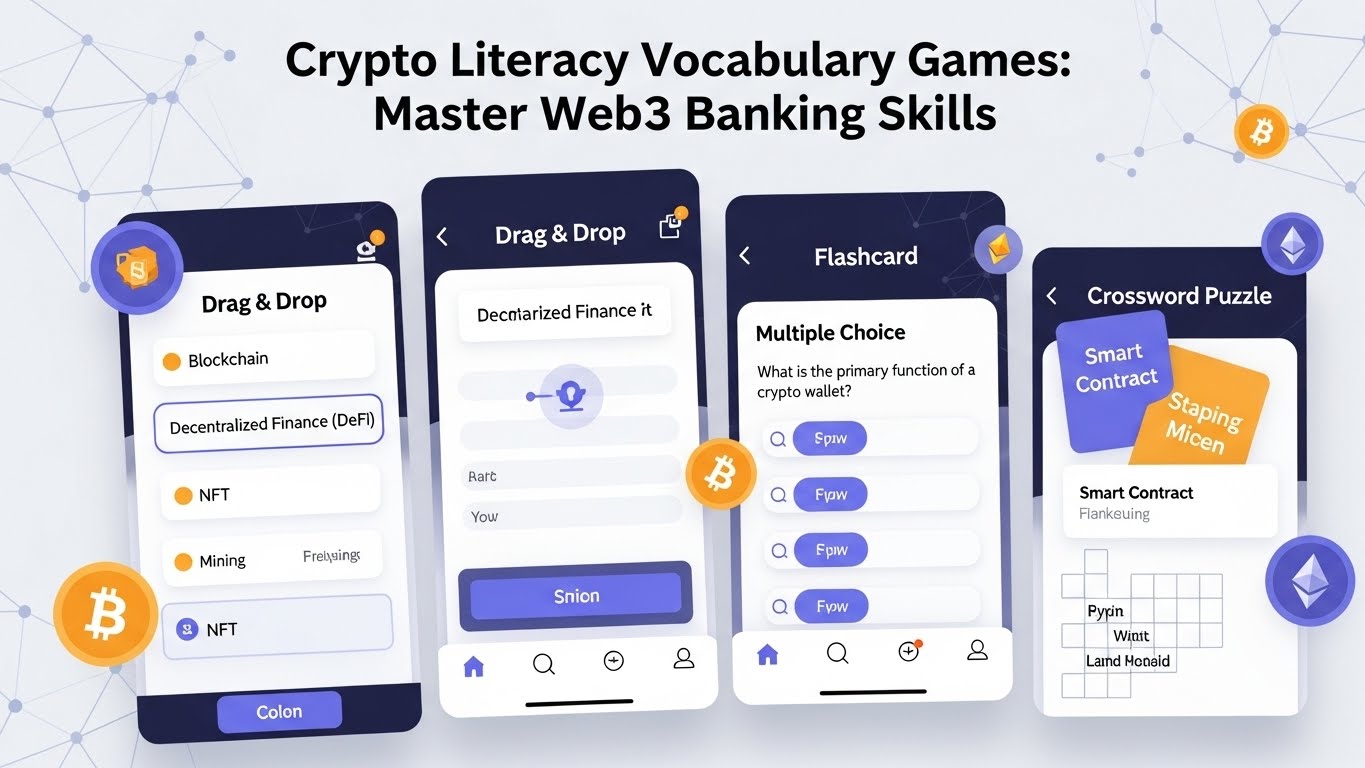
Crypto literacy vocabulary games represent an innovative approach to mastering blockchain terminology while simultaneously understanding the complex world of Web3 banking. These interactive educational tools transform intimidating technical jargon into digestible, memorable concepts that empower users to navigate decentralized finance with confidence. Within the first few months of 2025, educational platforms have reported a 340% increase in engagement when gamification elements are integrated into blockchain education programs, proving that learning through play isn’t just effective for children but equally powerful for adults entering the cryptocurrency space.
Foundation of Crypto Literacy in Modern Banking
The financial landscape has undergone a seismic shift over the past decade, with Web3 banking emerging as a disruptive force that challenges centuries-old banking paradigms. Traditional financial institutions operated on centralized systems where intermediaries controlled transactions, maintained records, and held ultimate authority over customer assets. The advent of blockchain technology introduced a radical alternative where peer-to-peer transactions occur without intermediaries, smart contracts execute automatically based on predetermined conditions, and users maintain complete sovereignty over their digital assets.
However, this revolutionary system comes with a steep learning curve that has prevented mass adoption. Terms like staking, liquidity pools, gas fees, non-custodial wallets, and consensus mechanisms sound like foreign language to newcomers. This knowledge gap creates a significant barrier to entry, leaving millions of potential users on the sidelines despite their interest in participating in the decentralized economy. Cryptocurrency terminology encompasses hundreds of specialized terms that span computer science, economics, cryptography, and finance, making it one of the most interdisciplinary fields in modern technology.
The importance of digital finance literacy cannot be overstated in an era where financial inclusion depends increasingly on technological access and understanding. Studies conducted by leading blockchain research institutes reveal that individuals who possess strong foundational knowledge of cryptocurrency concepts are 73% more likely to successfully participate in DeFi protocols without falling victim to scams or making costly mistakes. This statistical reality underscores why educational innovation in this space matters tremendously for both individual financial wellbeing and the broader adoption of blockchain technology.
How Crypto Literacy Vocabulary Games Transform Learning Experiences
Traditional educational methods often struggle to maintain engagement when teaching highly technical subjects, particularly those involving abstract concepts like blockchain networks and cryptographic principles. This is precisely where crypto literacy vocabulary games demonstrate their transformative power. By leveraging game mechanics such as point systems, achievement badges, competitive leaderboards, and narrative-driven challenges, these platforms convert dry memorization exercises into compelling experiences that naturally motivate continued learning.
The psychological principles underlying gamified education are well-documented in academic research. When learners receive immediate feedback on their progress, experience incremental achievements, and feel a sense of autonomy in their learning journey, retention rates increase dramatically compared to passive learning methods. Blockchain vocabulary games implement these principles by creating scenarios where users must apply terminology in realistic contexts rather than simply memorizing definitions in isolation.
Consider a vocabulary game that simulates running a decentralized autonomous organization where players must make decisions using proper crypto terminology to succeed. Instead of memorizing that “governance tokens” grant voting rights in protocol decisions, players experience the practical application by using their virtual governance tokens to vote on proposals, seeing immediate consequences of their choices, and understanding the term through lived experience within the game environment. This experiential learning creates neural pathways that strengthen memory retention and practical understanding simultaneously.
Furthermore, these games address different learning styles effectively. Visual learners benefit from graphic representations of blockchain networks and transaction flows. Auditory learners can access pronunciation guides and explanatory audio clips. Kinesthetic learners engage through interactive drag-and-drop exercises and simulation activities. By accommodating diverse learning preferences, crypto learning platforms ensure that no potential user is excluded due to incompatible teaching methodologies.
Essential Vocabulary Categories in Web3 Banking Education
Decentralized banking education must cover several critical vocabulary categories to provide comprehensive understanding. The first category involves fundamental blockchain concepts including distributed ledgers, nodes, miners, validators, and consensus algorithms. These foundational terms establish the technological infrastructure upon which all cryptocurrency systems operate. Without grasping these basics, learners cannot progress to more advanced concepts or understand why blockchain represents such a significant innovation compared to traditional databases.
The second essential category encompasses transaction-related terminology such as gas fees, transaction hashes, block confirmations, mempool, and network congestion. Understanding these terms directly impacts a user’s ability to execute transactions efficiently and economically. Many newcomers have unnecessarily overpaid for transactions or experienced delayed transfers simply because they lacked basic knowledge about how network fees function and how to optimize transaction timing.
Security vocabulary forms the third critical category, including terms like private keys, seed phrases, two-factor authentication, cold storage, hot wallets, multi-signature wallets, and smart contract audits. This knowledge area directly correlates with asset protection, as the decentralized nature of Web3 banking places security responsibility entirely on individual users rather than centralized institutions. A single misunderstanding about seed phrase security could result in permanent asset loss, making this vocabulary category potentially the most financially consequential.
DeFi-specific terminology represents the fourth major category, covering concepts like yield farming, liquidity mining, impermanent loss, automated market makers, lending protocols, and collateralization ratios. As Web3 banking increasingly centers on DeFi applications, understanding these specialized terms becomes essential for anyone seeking to generate passive income or leverage their cryptocurrency holdings effectively.
Implementing Effective Game Mechanics for Vocabulary Retention
The most successful crypto literacy vocabulary games incorporate specific game mechanics that optimize learning outcomes. Progressive difficulty scaling ensures that players encounter basic terms initially, then gradually face more complex vocabulary as their competence grows. This scaffolding approach prevents overwhelming newcomers while maintaining challenge levels that keep experienced learners engaged.
Spaced repetition algorithms represent another crucial mechanic, presenting terms at scientifically optimized intervals to maximize long-term retention. Rather than cramming all vocabulary in a single session, these systems identify which terms individual users struggle with and strategically re-introduce them at moments when memory consolidation is most effective. Research in cognitive science demonstrates that spaced repetition can improve retention rates by up to 200% compared to massed practice.
Contextual learning scenarios immerse players in realistic situations where vocabulary application matters. Instead of matching definitions to terms in isolation, players might navigate a simulated DeFi protocol where they must identify the correct action based on their understanding of terms like “slippage tolerance” or “price impact.” This context-based approach ensures that vocabulary knowledge translates into practical competence rather than remaining abstract theoretical understanding.
Social learning features enable collaborative vocabulary building where users can challenge friends, join study groups, and participate in community-wide events. The competitive element motivates consistent engagement, while the collaborative aspects allow learners to clarify confusions and share mnemonic devices that aid memorization. Many platforms report that users who participate in social learning features demonstrate 40% higher completion rates than those who learn in isolation.
The Role of Gamification in Breaking Down Web3 Complexity
Blockchain education faces a unique challenge compared to other technical subjects because it simultaneously demands understanding of multiple complex disciplines. A comprehensive grasp of cryptocurrency requires knowledge spanning cryptography, computer networking, economics, game theory, and financial systems. This interdisciplinary nature intimidates many potential learners who feel overwhelmed before they even begin.
Gamification addresses this challenge by chunking complex information into manageable segments disguised as game levels or missions. Instead of confronting the entire blockchain ecosystem at once, learners might spend one game session focused exclusively on understanding consensus mechanisms, another on wallet security, and a third on DeFi protocols. This modular approach respects cognitive load limitations while ensuring comprehensive coverage over time.
The reward systems embedded in vocabulary games create positive reinforcement loops that sustain motivation during challenging learning phases. When a player struggles with a particularly difficult concept like “zero-knowledge proofs,” earning a special achievement badge after finally mastering the term provides emotional satisfaction that buffers against frustration and encourages persistence. These psychological rewards activate the same neural pathways as tangible rewards, making them surprisingly effective motivational tools.
Narrative elements transform abstract vocabulary learning into story-driven adventures where terminology mastery enables progress through engaging plots. Some crypto learning platforms have created elaborate storylines where players assume roles as blockchain detectives solving crypto crimes, requiring them to understand technical terminology to gather clues and solve cases. This narrative framework provides meaning and purpose to vocabulary acquisition beyond the instrumental goal of financial literacy.
Bridging Traditional Finance and Decentralized Banking Through Language
One significant advantage of crypto literacy vocabulary games is their ability to bridge the conceptual gap between traditional finance and Web3 banking by drawing explicit connections between familiar and novel terms. For instance, games might present scenarios comparing traditional bank savings accounts with DeFi lending protocols, highlighting parallels and differences using both conventional financial terminology and cryptocurrency equivalents.
This comparative approach helps learners leverage their existing financial knowledge as a foundation for understanding blockchain innovations rather than treating crypto as an entirely foreign domain. When a game explains that a “liquidity pool” functions somewhat like a traditional market maker but operates algorithmically without human intermediaries, it anchors new information to existing mental models, accelerating comprehension and retention.
The translation between traditional and decentralized finance terminology also empowers users to communicate effectively across both domains. As hybrid financial services emerge that integrate blockchain technology with conventional banking infrastructure, professionals who understand both vocabulary sets position themselves advantageously in the evolving financial sector. Educational platforms that recognize this transitional landscape prepare learners for practical real-world applications rather than purely theoretical knowledge.
Moreover, understanding the linguistic connections helps demystify blockchain technology by revealing that many supposedly revolutionary concepts actually have precedents in traditional finance, just implemented through novel technological means. This realization reduces intimidation and makes cryptocurrency terminology feel more accessible to those with existing financial experience.
Measuring Progress and Competency in Crypto Vocabulary
Effective blockchain vocabulary games incorporate robust assessment mechanisms that provide learners with clear feedback about their developing competency. These assessments range from quick quizzes embedded within gameplay to comprehensive certification tests that validate mastery of specific vocabulary domains. The immediate feedback characteristic of game-based assessments enables learners to identify knowledge gaps quickly and focus their study efforts efficiently.
Adaptive testing algorithms adjust question difficulty based on user performance, ensuring that assessments remain appropriately challenging regardless of skill level. A beginner might encounter questions distinguishing between “hot wallets” and “cold wallets,” while an advanced learner faces scenarios requiring nuanced understanding of “elliptic curve cryptography” implications for wallet security. This personalization ensures that assessments provide valuable information about individual progress rather than comparing all users against a single standardized benchmark.
Progress visualization tools transform abstract learning metrics into tangible representations that motivate continued engagement. Skill trees might display mastered vocabulary categories alongside locked advanced terms, creating a visual roadmap of the learning journey. Experience point systems quantify progress numerically, while achievement systems celebrate specific milestones like mastering all security-related vocabulary or completing a perfect round of advanced DeFi terminology.
These measurement systems serve dual purposes by simultaneously providing learners with meaningful feedback about their development and generating data that platform developers use to refine educational content. When analytics reveal that users consistently struggle with certain terms, developers can enhance those explanations, add additional contextual examples, or create supplementary mini-games targeting the problematic vocabulary.
Real-World Applications of Enhanced Crypto Literacy
The practical benefits of mastering cryptocurrency terminology through vocabulary games extend far beyond theoretical knowledge. Users who understand terms like “slippage,” “gas optimization,” and “transaction priority” can execute blockchain transactions more efficiently and economically, potentially saving hundreds or thousands of dollars annually depending on their activity level. This direct financial impact makes vocabulary mastery an investment with measurable returns.
Enhanced literacy also reduces vulnerability to scams and fraudulent schemes that exploit terminology confusion. Scammers frequently use legitimate-sounding crypto jargon to create false credibility, but users who genuinely understand terms can identify inconsistencies and red flags that reveal malicious intent. For example, someone who truly understands what “smart contract audits” entail will immediately question a project claiming to be audited without providing verifiable audit documentation.
Career opportunities in the blockchain sector increasingly require fluency in specialized vocabulary. Whether pursuing roles in blockchain development, cryptocurrency trading, DeFi protocol design, or blockchain consulting, professional success depends on communication competency using industry-standard terminology. Digital finance literacy acquired through vocabulary games provides the linguistic foundation necessary for technical discussions, collaboration with specialists, and credible representation in professional contexts.
Beyond individual benefits, widespread crypto literacy contributes to healthier blockchain ecosystems overall. When user bases understand terminology and concepts thoroughly, they make more informed governance decisions in decentralized autonomous organizations, provide more constructive feedback to protocol developers, and contribute more meaningfully to community discussions. This collective elevation of knowledge quality strengthens the entire Web3 infrastructure.
Overcoming Common Challenges in Crypto Education Through Gamification
Traditional blockchain education approaches face significant dropout rates as learners encounter frustration with technical complexity, motivation wanes due to lack of immediate applicability, or time constraints prevent consistent study. Crypto literacy vocabulary games address these challenges through design features specifically engineered to sustain engagement and overcome common obstacles.
The challenge of technical complexity finds resolution through progressive disclosure, where games initially shield learners from overwhelming detail while gradually introducing complexity as foundational understanding solidifies. A beginner might first learn that “consensus mechanisms” enable network agreement on transaction validity, with deeper technical explanations of proof-of-work versus proof-of-stake mechanisms reserved for later game stages after the basic concept has been internalized.
Motivation challenges receive attention through varied reward structures that provide both intrinsic and extrinsic incentives for continued learning. Intrinsic motivation comes from the satisfaction of solving increasingly difficult puzzles and the intellectual pleasure of understanding previously mysterious concepts. Extrinsic motivation derives from leaderboard rankings, collectible achievement badges, unlockable content, and sometimes even cryptocurrency rewards distributed by platforms to recognize learning accomplishments.
Time constraint issues are addressed through modular game design that accommodates various session lengths. Users can engage meaningfully in five-minute micro-learning sessions during commute time or dedicate extended periods to immersive learning experiences during weekends. This flexibility respects the reality that adult learners balancing multiple responsibilities need educational tools that adapt to their schedules rather than demanding rigid time commitments.
The isolation often experienced in self-directed learning finds remedy through community features that connect learners with peers facing similar challenges. Discussion forums allow users to ask questions and share insights. Cooperative game modes enable collaborative problem-solving where multiple players work together to solve vocabulary challenges. These social elements transform solitary study into shared experiences that provide emotional support and intellectual enrichment.
Future Trends in Crypto Vocabulary Education and Web3 Learning
The evolution of crypto learning platforms continues accelerating as technological advances enable increasingly sophisticated educational experiences. Artificial intelligence integration promises personalized learning pathways that adapt in real-time to individual user performance, learning style preferences, and stated educational goals. These AI tutors will identify subtle patterns in user responses that reveal conceptual misunderstandings, then dynamically generate customized explanations and practice exercises targeting those specific gaps.
Virtual reality and augmented reality technologies are beginning to create immersive blockchain education environments where learners can visualize abstract concepts in three-dimensional space. Imagine donning a VR headset and literally walking through a blockchain network, observing nodes communicating with each other, watching transactions propagate through the mempool, and seeing smart contracts execute as visual programs. This spatial representation of abstract processes could revolutionize comprehension for visual and kinesthetic learners who struggle with purely text-based explanations.
The integration of real cryptocurrency rewards for learning achievements represents another emerging trend. Some platforms now distribute small amounts of actual tokens to users who complete vocabulary mastery certifications or achieve high scores in educational games. This approach creates tangible value for time invested in learning while simultaneously introducing learners to the practical experience of owning and managing cryptocurrency, reinforcing theoretical vocabulary knowledge through hands-on practice.
Cross-platform integration will enable vocabulary learning to occur seamlessly across multiple contexts. Users might encounter vocabulary challenges within their actual cryptocurrency wallets, receive push notifications with daily vocabulary quizzes on their smartphones, and participate in live multiplayer vocabulary tournaments during commutes. This omnipresent educational infrastructure ensures that learning opportunities exist whenever users have spare moments, maximizing efficiency in an attention-scarce world.
Building a Comprehensive Crypto Literacy Curriculum Through Games
Designing effective decentralized banking education requires careful curriculum planning that ensures comprehensive coverage while maintaining logical progression. Foundational modules introduce basic blockchain concepts and essential terminology like blocks, chains, transactions, and addresses. These building blocks establish the conceptual framework upon which all subsequent learning depends.
Intermediate modules branch into specialized domains including different blockchain architectures, various consensus mechanisms, wallet types and security practices, and fundamental DeFi concepts. This stage acknowledges that learners may have different interest areas within the crypto space and allows some degree of personalization in learning paths. Someone interested in NFTs might prioritize vocabulary related to digital art and collectibles, while another user focused on yield generation would emphasize DeFi protocol terminology.
Advanced modules tackle sophisticated concepts like layer-two scaling solutions, cross-chain interoperability, advanced cryptographic techniques, complex DeFi strategies, and blockchain governance models. These modules assume strong foundational knowledge and challenge learners to integrate multiple concept areas simultaneously, reflecting the interdisciplinary nature of real-world blockchain applications.
Certification systems validate comprehensive mastery across multiple modules, providing portable credentials that learners can showcase when seeking employment, participating in governance decisions, or establishing credibility within crypto communities. These certifications gain value as they become recognized standards within the industry, creating incentive structures that encourage thorough rather than superficial learning.
The Psychology Behind Effective Vocabulary Game Design
Understanding cognitive science principles enables developers to create crypto literacy vocabulary games that maximize learning efficiency. Working memory limitations dictate that effective games present information in small chunks rather than overwhelming learners with extensive terminology lists. Most research suggests that humans can actively process approximately four to seven distinct pieces of information simultaneously, informing the design decision to limit new vocabulary introductions to this range per game session.
The testing effect demonstrates that retrieval practice strengthens memory more effectively than repeated studying, explaining why effective vocabulary games emphasize active recall through quizzes and challenges rather than passive review of definitions. When learners must actively retrieve a term’s meaning from memory rather than simply reading the definition again, they strengthen neural pathways associated with that information, improving long-term retention substantially.
Elaborative encoding principles suggest that connecting new information to existing knowledge creates stronger memories than isolated fact memorization. Games implementing this principle might ask learners to generate their own examples of how a cryptocurrency term relates to their personal experience or to explain concepts using analogies. This deep processing creates multiple retrieval cues that make information more accessible when needed in practical situations.
The generation effect reveals that information learners produce themselves becomes more memorable than information they passively receive. Vocabulary games leveraging this principle might challenge users to create their own sentences using new terms correctly, generate metaphors explaining complex concepts, or even design their own hypothetical blockchain protocols incorporating terminology they’ve learned. This active construction of knowledge produces superior retention compared to recognition-based learning alone.
Creating an Inclusive Crypto Learning Environment
Effective Web3 banking education must accommodate learners from diverse backgrounds with varying levels of prior knowledge, technical sophistication, and learning preferences. Accessibility features ensure that vocabulary games serve users with disabilities through screen reader compatibility, adjustable text sizes, color-blind friendly design choices, and alternative input methods beyond standard keyboard and mouse interfaces.
Multilingual support expands access to non-English speakers, recognizing that blockchain technology represents a global phenomenon not limited to English-speaking populations. Quality localization extends beyond simple translation to encompass cultural adaptation, ensuring that examples and scenarios resonate with learners from different cultural contexts. Terms sometimes lack direct equivalents across languages, requiring thoughtful explanation of concepts rather than literal word-for-word translation.
Varying difficulty levels and optional assistance features accommodate users spanning absolute beginners to those with substantial existing knowledge seeking to formalize and expand their understanding. Adjustable hint systems allow struggling learners to receive graduated levels of assistance without feeling frustrated, while advanced users can disable hints entirely to maximize challenge. This flexibility prevents both boredom from excessive simplicity and discouragement from overwhelming difficulty.
Community guidelines and moderation systems create welcoming environments where learners feel comfortable asking questions and acknowledging knowledge gaps without fear of ridicule. The cryptocurrency space has unfortunately earned a reputation for gatekeeping behavior and condescension toward newcomers. Educational platforms must actively counteract this tendency by fostering cultures of encouragement, patience, and mutual support among community members.
Measuring the Effectiveness of Game-Based Crypto Education
Evaluating whether crypto literacy vocabulary games actually achieve their educational objectives requires rigorous assessment methodologies. Pre-test and post-test comparisons measure knowledge gains by assessing users’ vocabulary comprehension before and after engaging with game-based learning, providing quantitative evidence of educational impact. Statistically significant improvements in test scores validate that learning occurred beyond what chance or maturation alone would produce.
Retention studies examine whether knowledge persists over time by reassessing users weeks or months after completing vocabulary games. Educational approaches that produce only short-term memory gains without durable retention fail to serve learners adequately, as practical application often occurs long after initial learning. Effective games create lasting memory traces that remain accessible when users encounter terminology in real-world contexts months later.
Application assessments evaluate whether vocabulary knowledge translates into practical competency by observing whether users can successfully execute real blockchain transactions, navigate actual DeFi protocols, or analyze smart contracts using terminology they learned through games. This highest level of assessment validates that learning extended beyond rote memorization to genuine understanding applicable in authentic situations.
Comparative studies examining game-based learning against traditional educational approaches provide evidence about relative effectiveness. When learners using vocabulary games demonstrate superior outcomes compared to those using conventional textbooks or video lectures, it validates the additional development effort required to create game-based educational content. These comparisons help educators and platforms allocate resources toward the most effective teaching methodologies.
Integrating Crypto Vocabulary Games into Broader Financial Education
Digital finance literacy extends beyond cryptocurrency to encompass traditional banking, investment principles, risk management, and personal financial planning. The most comprehensive educational approaches integrate crypto vocabulary learning within holistic financial education frameworks that help learners understand how blockchain-based finance fits within the broader financial landscape.
This integrated approach prevents the common pitfall of crypto enthusiasts who possess deep blockchain knowledge but lack fundamental financial literacy principles. Understanding cryptocurrency terminology means little if a user doesn’t grasp basic concepts like diversification, risk-adjusted returns, liquidity management, and tax implications. Comprehensive platforms address both crypto-specific vocabulary and general financial terminology, creating financially sophisticated users rather than narrow technical specialists.
Case studies and scenario-based learning demonstrate how cryptocurrency fits within diversified investment portfolios, when decentralized finance tools offer advantages over traditional banking services, and how to evaluate trade-offs between conventional and blockchain-based financial approaches. This balanced perspective empowers users to make informed decisions about when to utilize crypto solutions versus traditional alternatives based on their specific circumstances and objectives.
Regulatory and compliance vocabulary receives attention in integrated programs, ensuring learners understand terms like KYC, AML, securities regulations, and tax reporting requirements. As regulatory frameworks surrounding cryptocurrency continue evolving globally, staying informed about compliance terminology becomes increasingly important for anyone participating in digital finance. Ignorance of regulatory requirements creates legal and financial risks that comprehensive education must address.
Conclusion
The transformation of global finance through blockchain technology demands widespread literacy that empowers individuals to participate confidently in emerging decentralized systems. Crypto literacy vocabulary games represent a powerful educational innovation that addresses the accessibility challenges preventing mass adoption of Web3 banking solutions. By combining proven pedagogical principles with engaging game mechanics, these platforms transform intimidating technical terminology into approachable, memorable knowledge that serves as the foundation for practical competency.
As we progress further into 2026 and beyond, the gap between those who understand blockchain systems and those who remain mystified by cryptocurrency terminology will increasingly determine economic opportunity and financial sovereignty. Educational tools that make comprehensive crypto literacy accessible to everyone regardless of technical background or prior knowledge contribute to a more equitable financial future where participation isn’t limited to technical elites.
Whether you’re an absolute beginner just discovering blockchain technology or an experienced user seeking to formalize and expand your knowledge, engaging with crypto literacy vocabulary games represents a strategic investment in your financial future. The time invested in mastering fundamental terminology pays dividends through more confident decision-making, reduced vulnerability to scams, access to career opportunities, and the ability to leverage decentralized financial tools effectively.
Take action today by exploring the growing ecosystem of gamified blockchain education platforms. Commit just fifteen minutes daily to vocabulary practice and watch as previously incomprehensible concepts become clear, enabling you to navigate the exciting world of decentralized finance with competence and confidence. The future of Web3 banking belongs to those who invest in their education now, building the literacy foundation necessary for success in the blockchain era.
See more: El Salvador Bitcoin Experiment Ends: Crypto Buying Continues
