


Few questions have dominated financial headlines more than this one: how has Bitcoin performance since Trump took office shaped up for investors, traders, and the broader crypto market? From euphoric all-time highs driven by promises of a “crypto capital of the world” to a bruising sell-off that wiped trillions from digital asset markets, the story of Bitcoin under Donald Trump’s second presidency is one of extraordinary volatility, regulatory transformation, and hard lessons about the limits of political tailwinds. If you’ve been watching your portfolio swing with every presidential tweet, executive order, or tariff announcement, this comprehensive breakdown is exactly what you need.
Bitcoin Performance Since Trump Took Office: The Full Timeline
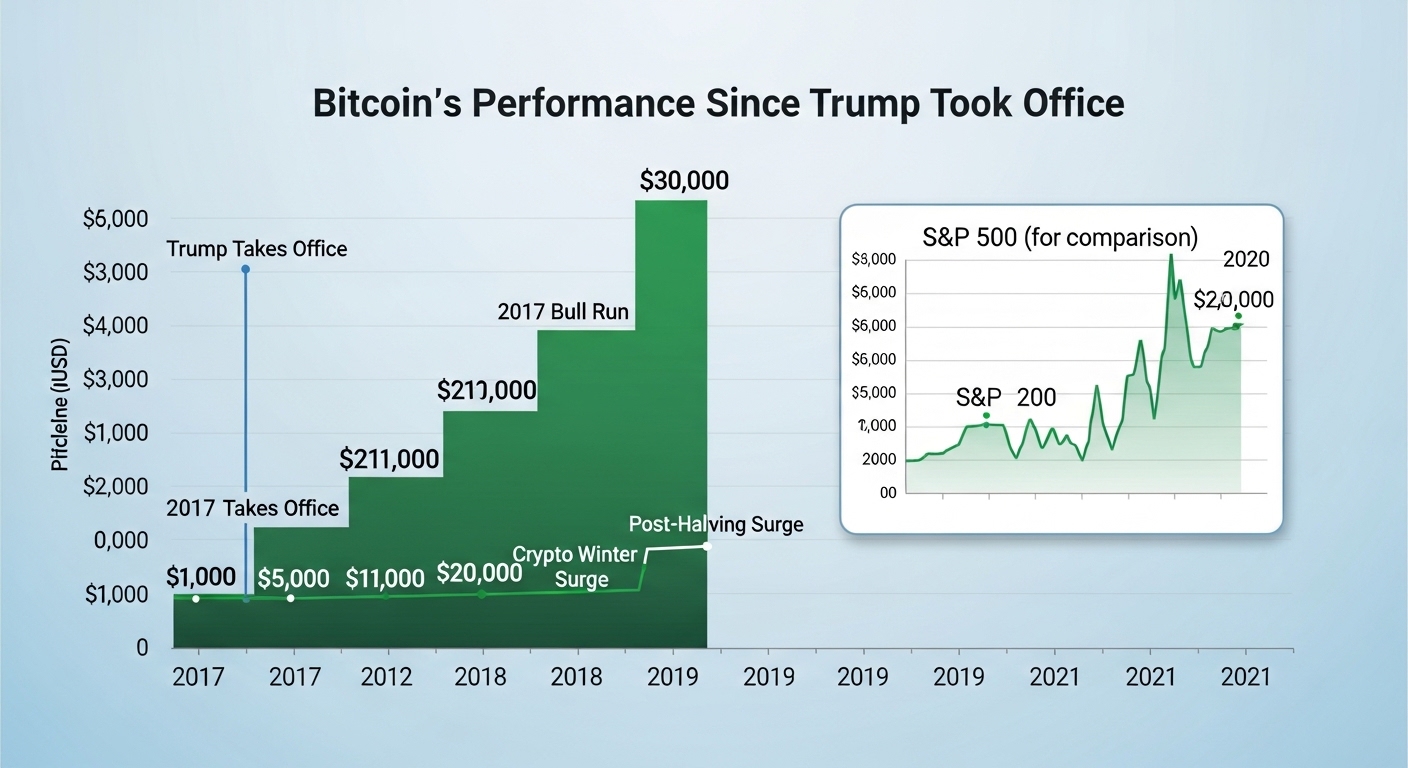
When Donald Trump won the 2024 presidential election in November, Bitcoin was trading at approximately $69,539. The market didn’t wait for inauguration day to react. Investor sentiment surged instantly on the expectation that a pro-crypto White House would tear down the regulatory walls that had frustrated the industry for years. Since Trump’s re-election in November 2024, Bitcoin surged 60 percent, rising from roughly $69,539 at close on Election Day to record levels above $109,000 by Inauguration Day.
By January 20, 2025 — the day Trump was officially sworn in — Bitcoin’s price under Trump had already climbed to approximately $109,114, marking a stunning pre-inaugural rally. The market was pricing in what many believed would be a golden era for cryptocurrency in America.
Inauguration Day and the Initial Euphoria
The optimism surrounding Trump’s return to the White House was palpable. Among his first actions in office was an executive order declaring his intent to make the United States the global cryptocurrency capital. Trump signed a law to support federal backing of cryptocurrency, dissolved a Department of Justice team focused on enforcement of crypto regulation, and the Securities and Exchange Commission dropped crypto-related enforcement actions.
The administration also moved swiftly on appointments. Trump’s cryptocurrency policies included appointing pro-crypto figures to key regulatory roles, such as naming Paul Atkins as the new SEC chair. After years of aggressive enforcement under former SEC Chair Gary Gensler, this was a dramatic reversal that the crypto industry had long lobbied for.
The Strategic Bitcoin Reserve: A Historic Policy Shift
Trump signed an executive order establishing a Strategic Bitcoin Reserve and a US Digital Asset Stockpile. The White House framed this as a matter of national strategic advantage, noting that being among the first nations to establish such a reserve could offer significant geopolitical and economic benefits.
The U.S. Senate advanced key pro-crypto legislation such as the establishment of the Strategic Bitcoin Reserve and the Digital Asset Stockpile, aimed at maintaining control of Bitcoin seized as part of criminal or civil asset forfeiture proceedings. This was not merely symbolic — it signaled that the United States government was treating Bitcoin as a legitimate sovereign asset for the first time in history.
The Trump crypto policy approach rippled immediately through markets. Investor optimism and improving regulatory clarity pushed Bitcoin’s price upward through the spring and summer of 2025, eventually carrying the asset to new all-time highs.
Bitcoin Reaches Record All-Time Highs in Mid-2025
The culmination of the post-election rally came in the spring and early summer of 2025. Bitcoin reached an all-time high of $111,970, marking a 2.6 percent increase from its previous Inauguration Day peak of $109,114. For a brief, electric moment, the bulls were firmly in control.
But Bitcoin wasn’t done climbing. Fueled by continued institutional interest, spot Bitcoin ETF inflows, and growing global adoption, BTC price history during Trump’s second term continued to set records. Following developments around the Strategic Bitcoin Reserve and interest rate cuts by the US Federal Reserve, Bitcoin reached a record $126,199. That peak, hit in October 2025, represented roughly an 80 percent gain from the day Trump was re-elected just under a year earlier.
The Role of Bitcoin ETFs in the Rally
One of the structural drivers behind Bitcoin’s surge was the maturation of the Bitcoin ETF market. Spot Bitcoin ETFs had been approved by the SEC in January 2024 under the Biden administration, but they found a far more hospitable regulatory environment under Trump. Total assets value in Bitcoin spot ETFs fell by October 2025 but still stood at about $125 billion, underscoring just how much institutional capital had flowed into the space during the Trump era.
These vehicles gave traditional investors — pension funds, wealth managers, and retail savers — an easy, regulated way to gain Bitcoin exposure without holding the asset directly. Their popularity helped legitimize Bitcoin in a way that previous market cycles had not, and contributed meaningfully to the price appreciation seen in the first three quarters of 2025.
The Trump Family’s Deep Involvement in Crypto
An important — and controversial — dimension of Bitcoin under Trump’s presidency was the president’s family’s direct financial stake in the crypto sector. In his first year back in office, Trump launched a personal brand of cryptocurrency, with the bulk of profits going into his own companies, and continued his involvement with World Liberty Financial, an investment vehicle for other crypto assets owned by the Trump family.
Trump’s favourable view of cryptocurrency and his family’s heavy involvement in the industry raised concerns about the integrity of Trump’s administration and how he was using his influence as president. Democrats on the Senate Judiciary Committee called out the “pro-crypto agenda,” noting that the president had amassed enormous crypto holdings and gained personal income from crypto transactions since taking office.
The Trump meme coin, launched just before inauguration, initially surged to a peak of $45.57 before collapsing by more than 88 percent. These episodes added a layer of ethical complexity to what was otherwise a landmark period for crypto regulation under Trump.
The October 2025 Crash: When the Tailwind Became a Headwind
For all the gains Bitcoin made in the first three quarters of 2025, the fourth quarter delivered a painful reversal. The crash started on October 10 when Trump threatened to impose an extra 100% tariff on Chinese imports — on top of the 30% already in place. That spooked traders into dumping risky investments, from stocks to Bitcoin.
The irony was stark. The same political figure who had driven Bitcoin to record highs with promises of deregulation and institutional support now threatened the global trade environment in ways that crushed risk appetite across all asset classes. Bitcoin declined from above $126,000 in early October 2025 to below the $75,000 level by early February 2026, showing sustained downward pressure over the period.
The value of Bitcoin nearly doubled from when Trump was elected in November 2024 to its all-time high of around $126,000 per coin in October. Then, it all came undone.
Leverage Unwind: How Speculation Magnified the Pain
Trump’s election and the optimism about a game-changing year for crypto helped turbocharge rampant speculation and encouraged investors to take big risks. Many investors not only traded cryptos, they also borrowed heavily to scoop up even more cryptocurrencies in a process known as leveraging.
When prices turned, forced liquidations cascaded through the market. CoinGlass showed $2.56 billion in forced selling, and ETF flows looked tactical instead of confident dip buying. The speed and severity of the decline caught many participants off guard, reminding the market that leverage amplifies losses just as powerfully as it amplifies gains.
Hawkish Fed Fears Deepen the Decline
Adding fuel to the fire, some analysts noted that crypto weakness was linked to broad risk-off sentiment sparked by Trump’s nomination of Kevin Warsh as Federal Reserve chair. Warsh’s selection stoked concerns about a more hawkish policy mix and tighter financial conditions — pressures that historically weigh on high-beta assets, including cryptocurrencies.
The prospect of higher interest rates for longer is traditionally bearish for speculative assets. Bitcoin, for all its maturation as an institutional asset class, still carried significant sensitivity to monetary policy expectations. As the dollar strengthened on these hawkish signals, Bitcoin continued to retreat.
Where Does Bitcoin Stand Now? The 2026 Picture
As of early 2026, Bitcoin’s performance since Trump took office presents a mixed but ultimately still-positive picture when measured from election day. Bitcoin dropped to its lowest since Donald Trump retook the White House, erasing gains registered by the bellwether digital asset since his election victory, falling below $74,424.95 — the lowest price of 2025.
The world’s most popular cryptocurrency had fallen nearly 20 percent in value since the start of 2026. Yet measured from November 2024, investors who bought at Trump’s election are still sitting on meaningful gains, even after the sharp drawdown.
Bitcoin remains below its January 2025 level despite trading about 35% higher than in November 2024 and is roughly 27% below its October 2025 record. The asset finds itself in a complex position: significantly elevated from pre-election levels, but deeply scarred from a historic crash that erased roughly half its peak value in under four months.
How Does Bitcoin Compare to Traditional Markets?
The performance of Bitcoin vs gold and traditional equities offers important context. The S&P 500 and the Dow Jones Industrial Average went on to hit record highs in December 2025 and each ended the year with double-digit gains, while Bitcoin ended the year in the red. Gold, by contrast, posted its best annual return in decades.
Both gold and silver ended 2025 with their best returns since 1979, starting the new year strongly. Analysts noted that a group of investors who previously allocated to Bitcoin may have been showing increased interest in precious metals instead. This rotation from digital assets to physical ones reflected a broader investor recalibration in the face of macro uncertainty.
Legislation Stalls Despite Pro-Crypto Intent
One of the structural disappointments for the crypto market under Trump was the failure to pass comprehensive regulatory legislation. A Trump-backed bill to regulate the trading of cryptocurrency stalled in the U.S. Senate amid disagreement between banks and cryptocurrency firms, casting doubt over the implementation of the administration’s crypto agenda.
Regulatory clarity — long promised and eagerly anticipated — proved elusive in practice. While executive actions reshaped the enforcement landscape dramatically, the absence of durable congressional legislation left the crypto market without the stable legal foundation that institutional adoption ultimately requires.
H3: What Analysts Are Saying About Bitcoin’s Future Under Trump
Opinions among market strategists diverge sharply on where BTC price goes from here. Some see the current drawdown as a necessary correction in a long-term bull cycle. Others point to structural concerns about over-leverage, the narrowing Bitcoin-Nasdaq correlation, and the potential for a prolonged crypto winter.
Despite Fed rate cuts in 2024 and 2025, the Trump administration’s positive steps for the crypto market, and the emergence of more crypto-based instruments within the financial system, analysts noted that the market reached a point below the return levels that investors were accustomed to seeing in past crypto bull markets.
One bullish camp argues that Bitcoin price recovery hinges on a potential correction in precious metals, which could redirect institutional capital back toward digital assets. Bears point to the possibility of Bitcoin testing support levels far below current prices if macro conditions deteriorate further.
Conclusion
The story of Bitcoin performance since Trump took office is ultimately a story about political tailwinds meeting market realities. The Trump administration delivered on many of its pro-crypto promises — a Strategic Bitcoin Reserve, sweeping regulatory rollbacks, pro-crypto leadership at the SEC, and a cultural normalization of digital assets at the highest levels of government. Bitcoin responded by surging to record all-time highs above $126,000 in October 2025.
But markets are not governed by policy alone. Excessive leverage, tariff-driven risk-off sentiment, hawkish monetary policy fears, and the eternal boom-bust cycles of crypto all combined to erase much of that gain in spectacular fashion. As of early 2026, Bitcoin trades well below its Trump-era peak — but still above where it stood before Trump’s election.
Whether you’re a long-term holder, a short-term trader, or simply a curious observer trying to make sense of the most politically intertwined asset class in modern finance, understanding how Bitcoin has performed under Trump is essential. The next chapter is still being written.
Want to stay ahead of Bitcoin’s next move? Follow real-time price data, monitor regulatory developments from Washington, and study the macro environment carefully. The intersection of politics and crypto has never been more consequential — and neither has the need to stay informed.
See more;Bitcoin Recovers Near $67K Amid Rate and Geopolitical Risks
