


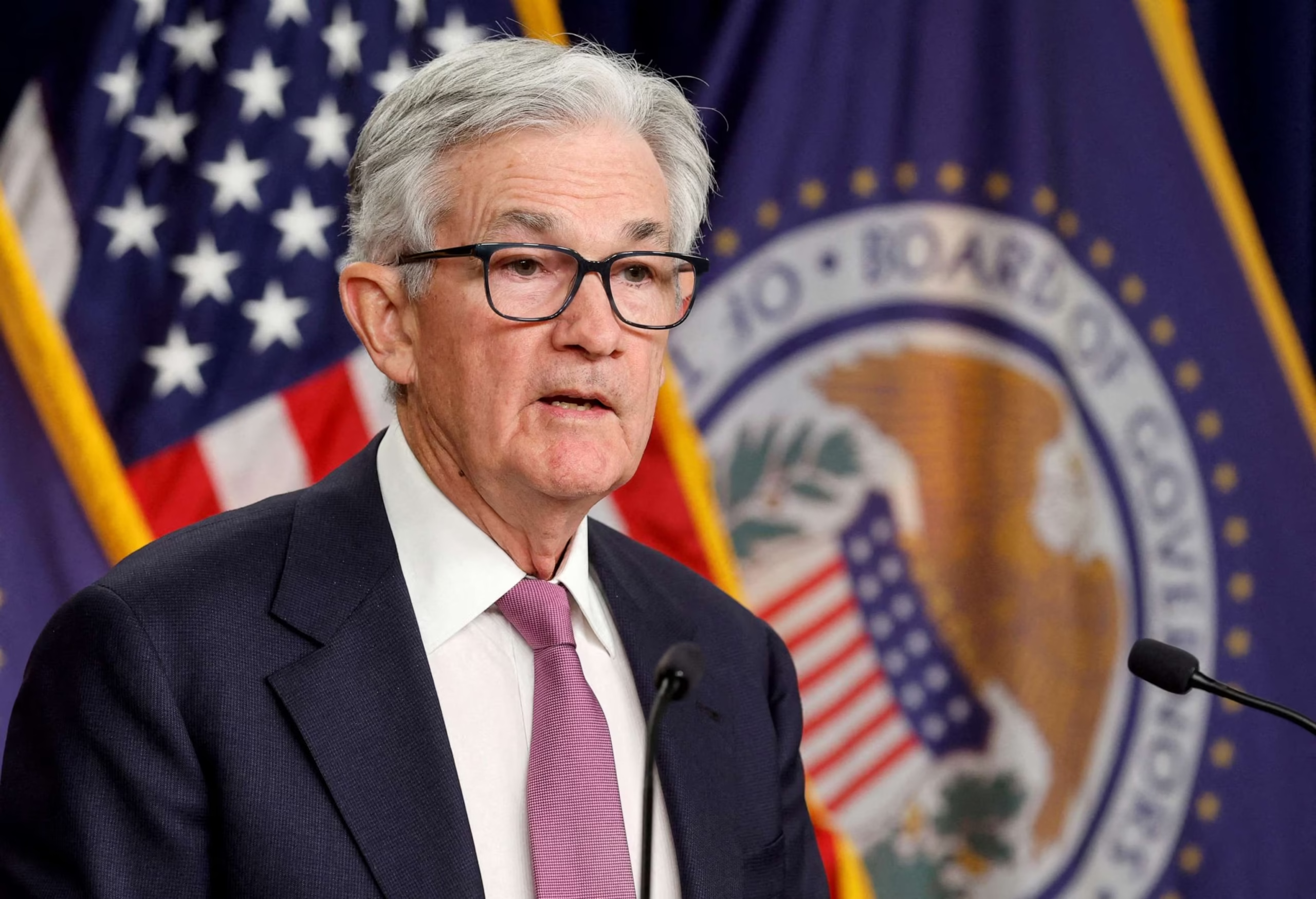
Powell took down the crypto rally with unexpectedly hawkish comments about monetary policy. Bitcoin price plummeted below critical support levels while the Ethereum drop accelerated investor concerns across digital asset markets. Within hours of Powell’s statements, the crypto market capitalisation erased billions in value, sending shockwaves through both retail and institutional investor communities. This comprehensive analysis explores how Powell’s rhetoric triggered the crypto selloff, what it means for Bitcoin and Ethereum prices, and the potential recovery trajectory for digital assets.
How Powell’s Comments Triggered the Crypto Crash
The Federal Reserve’s Hawkish Stance
When Jerome Powell took down the crypto rally, he did so by emphasising the Federal Reserve’s commitment to maintaining higher interest rates for an extended period. During his latest Federal Open Market Committee (FOMC) press conference, Powell delivered remarks that dashed investor hopes for near-term rate cuts. The Fed Chair’s insistence on data-dependent policy decisions, combined with concerns about persistent inflation, created immediate selling pressure across risk assets.
The Bitcoin price had been climbing steadily in anticipation of a more dovish Fed pivot. Investors had positioned themselves for potential rate cuts based on cooling inflation data. However, Powell’s comments shattered this optimistic narrative, triggering algorithmic selling and margin liquidations across cryptocurrency exchanges.
Why Cryptocurrencies Are Sensitive to Fed Policy
Digital assets like Bitcoin and Ethereum operate as risk-on investments in the modern financial ecosystem. When the Federal Reserve maintains a restrictive monetary policy, capital flows away from speculative assets toward safer, yield-bearing instruments like Treasury bonds. The Ethereum drop exemplified this dynamic as investors rotated out of crypto positions to capture higher risk-free returns.
Higher interest rates increase the opportunity cost of holding non-yielding assets like cryptocurrencies. Additionally, tighter financial conditions reduce liquidity in the system, making it more challenging for crypto projects to secure funding and for traders to maintain leveraged positions. This environment creates perfect conditions for cascading liquidations and accelerated price declines.
Bitcoin Price Analysis: Technical and Fundamental Breakdown
Critical Support Levels Breached
The Bitcoin price experienced a sharp correction following Powell’s comments, breaking through multiple technical support zones. Bitcoin fell from approximately $67,000 to below $62,000 within 48 hours, representing nearly an 8% decline. This move invalidated several bullish chart patterns that had been forming over the previous weeks.
Technical analysts identified the $60,000 level as critical psychological support. A sustained break below this threshold could trigger additional selling pressure, potentially pushing Bitcoin toward the $55,000-$58,000 range. The Relative Strength Index (RSI) moved into oversold territory, though history shows Bitcoin can remain oversold during prolonged bear phases.
Institutional Impact on Bitcoin Volatility

Institutional participation in Bitcoin markets has grown substantially through spot Bitcoin ETFs. However, when Powell took down the crypto rally, these same institutional vehicles amplified the selloff. ETF outflows accelerated as portfolio managers reduced risk exposure, creating additional downward pressure on Bitcoin’s price.
The correlation between Bitcoin and traditional equity indices strengthened during the downturn. This relationship suggests that Bitcoin hasn’t yet achieved its promised role as a hedge against traditional financial system risks. Instead, it trades increasingly like a high-beta technology stock, rising and falling with broader market sentiment and Fed policy expectations.
Mining Economics and Bitcoin Price Pressure
Bitcoin miners face increasing pressure when prices decline while mining difficulty remains elevated. The Bitcoin price drop reduces miner profitability, potentially forcing some operations to liquidate holdings to cover operational costs. This creates additional supply pressure at exactly the wrong time, potentially extending the correction phase.
Hash rate distribution and miner capitulation metrics provide important signals about Bitcoin’s price floor. When miners begin surrendering and selling reserves, it often marks a bottoming process. However, this capitulation phase can take weeks or months to fully develop, suggesting the Bitcoin price may face continued volatility.
Ethereum Drop: Analysing the Second-Largest Cryptocurrency
Layer-2 Competition and Ethereum Fundamentals
The Ethereum drop reflected both macroeconomic pressures and sector-specific challenges. Ethereum faces increasing competition from Layer-2 scaling solutions and alternative Layer-1 blockchains that offer faster transaction speeds and lower fees. When broader market conditions deteriorate, investors scrutinise these competitive dynamics more critically.
Ethereum’s transition to proof-of-stake created deflationary tokenomics through burning mechanisms. However, when Powell took down the crypto rally, even positive fundamental developments couldn’t overcome macro headwinds. The Ethereum drop saw prices fall from approximately $3,400 to below $3,100, erasing weeks of gains.
DeFi TVL and Ethereum’s Network Value
Decentralised Finance (DeFi) Total Value Locked (TVL) serves as a critical metric for Ethereum’s network utility. The Ethereum drop coincided with declining TVL across major DeFi protocols as users withdrew liquidity and reduced risk exposure. Lower TVL translates to reduced transaction fees and network activity, negatively impacting Ethereum’s value proposition.
Ethereum’s role as the backbone of DeFi, NFTs, and tokenisation remains intact, but challenging macro conditions test the network’s resilience. The correlation between Ethereum’s price and DeFi activity suggests that sustained recovery requires both improved Fed policy outlook and renewed interest in decentralised applications.
Ethereum’s Scaling Roadmap and Future Catalysts
Despite the recent Ethereum drop, the network’s long-term scaling roadmap presents potential catalysts for recovery. Upcoming upgrades focused on improving data availability and reducing Layer-2 costs could reignite investor interest. However, these technical improvements may take months to manifest in price action, especially if Powell maintains his hawkish stance.
Broader Cryptocurrency Market Impact
Altcoin Carnage and Risk-Off Sentiment
When Powell took down the crypto rally, altcoins suffered disproportionate losses compared to Bitcoin and Ethereum. Smaller-cap cryptocurrencies declined 15-25% as investors fled toward relative safety or exited crypto positions entirely. This altcoin underperformance reflects classic risk-off behaviour during market stress.
Projects with weak fundamentals or those operating in speculative niches experienced the most severe corrections. Meme coins, new token launches, and protocols with unclear revenue models saw particularly brutal selloffs. This differentiation suggests increasing market maturity, where investors distinguish between speculative gambling and projects with genuine utility.
Stablecoin Dynamics During the Selloff
Stablecoin supply metrics provide insight into whether investors are exiting crypto entirely or simply moving to the sidelines. During this correction, stablecoin supply remained relatively stable, suggesting many investors chose to wait in dollar-pegged tokens rather than converting back to fiat. This behaviour indicates belief in eventual recovery rather than complete capitulation.
However, stablecoin redemption rates deserve monitoring. If investors begin converting stablecoins back to fiat in significant volumes, it would signal deeper concerns about crypto’s near-term prospects and could extend the downturn.
Historical Context: Previous Fed-Driven Crypto Corrections
Comparing Current Situation to Past Fed Tightening Cycles
This isn’t the first time Federal Reserve policy has taken down the crypto rally. Historical analysis reveals patterns in how cryptocurrencies respond to monetary tightening. During the 2018 rate hike cycle, Bitcoin fell approximately 83% from peak to trough. While current conditions differ substantially, the playbook shows Fed policy exerts a powerful influence over crypto valuations.
The 2022 bear market offers a more recent comparison. As the Fed aggressively raised rates to combat inflation, the Bitcoin price declined from $69,000 to approximately $15,500, while Ethereum fell from $4,800 to below $900. Current corrections remain modest by comparison, suggesting either this represents an early-stage correction or crypto markets have matured to handle Fed policy shifts better.
Recovery Timeframes from Fed-Induced Selloffs
Historical data show crypto markets typically require an improved Fed policy outlook before establishing sustainable recoveries. The 2019 Bitcoin rally began as the Fed shifted toward rate cuts. Similarly, the 2023 recovery coincided with peak inflation readings and expectations for eventual Fed pivots.
The lesson: while Powell took down the crypto rally in the short term, eventual Fed policy loosening often creates powerful rallies in risk assets, including cryptocurrencies. The critical question becomes timing—how long will Powell maintain restrictive policy before economic conditions force a dovish shift?
Expert Perspectives on the Crypto Market Downturn
What Market Analysts Are Saying
Prominent cryptocurrency analysts offer varied perspectives on how Powell took down the crypto rally and what comes next. Some view the correction as a healthy consolidation after excessive rallies, creating better entry points for long-term investors. Others warn that continued Fed hawkishness could trigger more substantial declines.
Technical analysts point to key support levels that must hold to maintain a bullish market structure. The Bitcoin price needs to defend the $58,000-$60,000 zone to avoid triggering more severe technical damage. For Ethereum, maintaining support above $2,800 remains critical for preserving the broader uptrend.
Institutional Investor Sentiment
Institutional investors exhibit mixed reactions to the recent Ethereum drop and broader crypto weakness. Some view discounted prices as accumulation opportunities, believing long-term crypto adoption trends remain intact regardless of short-term Fed policy. Others have reduced exposure, prioritising capital preservation until clearer bullish catalysts emerge.
Survey data suggests institutional interest in crypto infrastructure and blockchain technology continues despite price volatility. This differentiation—between crypto as investment versus blockchain as technology—may prove increasingly important as the sector matures.
Investment Strategies During Fed-Induced Volatility
Dollar-Cost Averaging Through Market Turbulence

When Powell took down the crypto rally, disciplined investors implemented dollar-cost averaging strategies to navigate volatility. Rather than attempting to time perfect bottoms, systematic purchasing at regular intervals can build positions at favourable average prices during downturns.
This approach requires conviction in crypto’s long-term value proposition and ability to withstand further drawdowns. The Bitcoin price may experience additional weakness before establishing a firm bottom, making emotional discipline critical for strategy success.
Risk Management and Position Sizing
The recent Ethereum drop reinforces the importance of appropriate risk management. Cryptocurrency allocation should reflect individual risk tolerance and not represent capital needed for near-term obligations. Diversification across asset classes provides a buffer against crypto-specific volatility.
Stop-loss orders and defined exit strategies help protect capital during cascading corrections. While crypto investors often celebrate long-term holding, prudent risk management sometimes requires tactical position reductions to preserve capital for better opportunities.
Identifying Quality Projects During Corrections
Market downturns separate projects with genuine utility from pure speculation. When Powell took down the crypto rally, protocols with strong fundamentals, real user bases, and sustainable revenue models demonstrated relative resilience. These quality indicators become increasingly important during bear phases.
Investors should evaluate network metrics, development activity, and community engagement rather than focusing solely on price charts. Projects that continue building through bear markets often emerge as leaders during subsequent bull cycles.
What Comes Next: Recovery Scenarios and Outlook
Bullish Case for Crypto Recovery
The optimistic scenario envisions Powell eventually pivoting toward rate cuts as inflation normalises and economic growth slows. When monetary policy loosens, the Bitcoin price and broader crypto markets typically respond positively as liquidity returns and risk appetite recovers.
Additional bullish catalysts include spot Ethereum ETF approvals, increasing institutional adoption, and technological improvements across blockchain ecosystems. These factors could override Fed-related headwinds and establish new all-time highs despite current weakness.
Bearish Risks to Consider
The pessimistic outlook acknowledges that Powell took down the crypto rally and may continue suppressing prices if inflation proves stickier than expected. Persistent inflation would force the Fed to maintain restrictive policy longer, potentially triggering recession and an extended crypto bear market.
Additional risks include regulatory crackdowns, security breaches at major exchanges, or technological failures within prominent blockchain networks. The Ethereum drop could accelerate if Layer-2 competition intensifies or if Ethereum fails to deliver on scaling promises.
Most Likely Path Forward
The probable scenario involves continued volatility as crypto markets digest Fed policy while awaiting clearer directional catalysts. The Bitcoin price may consolidate in broad ranges, establishing support through time rather than catastrophic capitulation. Gradual accumulation by patient investors could set the foundation for eventual recovery.
This middle path requires investors to manage expectations for quick rebounds while maintaining exposure to capture eventual upside. When Powell eventually shifts policy direction, crypto markets will likely react swiftly, potentially leaving sidelined investors behind.
Conclusion
Understanding how Powell took down the crypto rally provides critical context for navigating current market conditions. The Bitcoin price and Ethereum drop reflect broader monetary policy dynamics rather than fundamental failures in cryptocurrency technology or adoption. While short-term volatility creates challenges, patient investors who maintain conviction in a digital asset’s long-term trajectory may discover compelling opportunities.
The relationship between Federal Reserve policy and cryptocurrency valuations will remain central to market performance throughout 2025. Monitoring Powell’s statements, inflation data, and Fed policy shifts provides essential insights for timing entry and exit points. As history demonstrates, periods of maximum pessimism often precede the most powerful rallies.
